
Call us:
+442036084550
Monday-Sunday (24 Hours)


 2026-08-08
James Smith
Businesses aim to grow, improve performance and stay ahead of the competition. To achieve this, they require the right processes because even the smallest problems can lead to wasted time, higher costs and inconsistent results. This is where understanding the Benefits of Lean Six Sigma can help companies improve the way they work and achieve sustainable growth.
Organisations across industries trust Lean Six Sigma as it provides them with a structured approach to solving problems and fostering continuous improvement. In this blog, you will explore the top 15 Benefits of Lean Six Sigma and discover how this methodology supports long-term business success. Let’s begin!
Lean Six Sigma is a business improvement methodology that combines the approaches of Lean and Six Sigma to help organisations improve efficiency, minimise waste, reduce errors and deliver higher-quality products or services. Lean focuses on removing activities that do not add value to customers, while Six Sigma uses data-driven analysis to identify and eliminate defects and process variations.
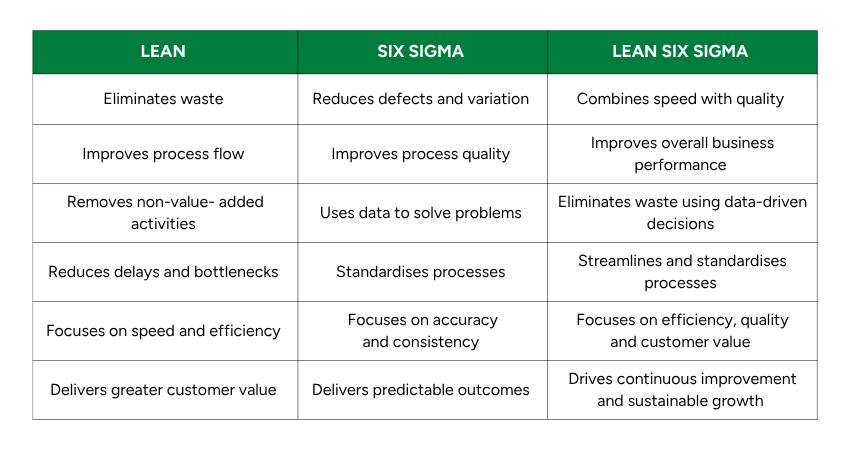
Lean Six Sigma uses structured frameworks like Define, Measure, Analyse, Improve and Control (DMAIC) to improve existing processes and Define, Measure, Analyse, Design and Verify (DMADV) to design new processes, products or services. These frameworks help organisations solve problems, make informed decisions and foster continuous improvement.
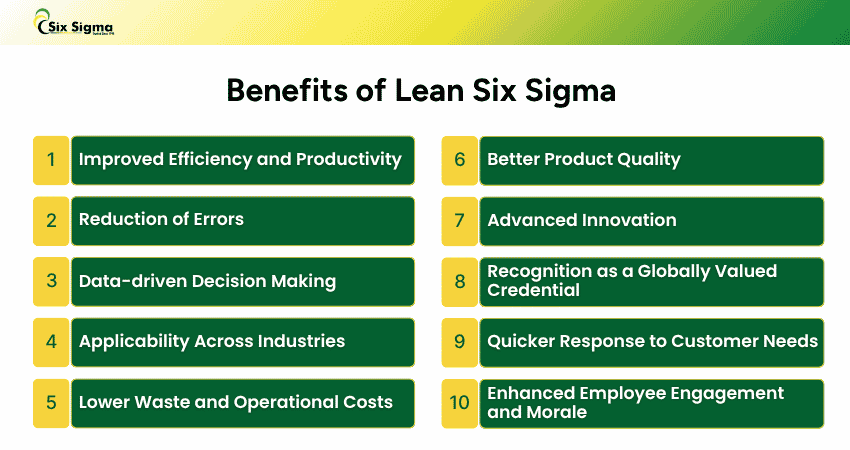
Lean Six Sigma delivers a wide range of benefits that help organisations improve performance and achieve sustainable growth. Beyond operational improvements, it fosters a culture of continuous improvement and strengthens an organisation's ability to adapt to changing business needs. Below are the top 15 Benefits of Lean Six Sigma and how they contribute to long-term business success:
Lean Six Sigma spots delays, bottlenecks and unnecessary steps within a process. By removing these activities, employees complete work faster and focus on tasks that create real value. This improves productivity without placing additional pressure on resources.
Six Sigma tools help teams identify the root causes of errors and process variation. By correcting these causes, it reduces errors, complaints and repeated problems. Also, it helps companies produce consistent and reliable results.
Lean Six Sigma supports companies in measuring process performance before making changes. Teams analyse reliable data, test possible solutions and monitor the results. This reduces guesswork and supports informed business decisions.
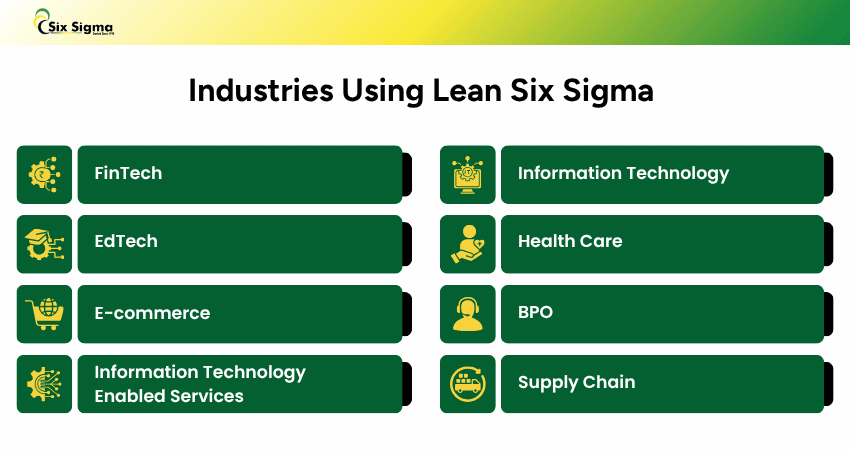
Lean Six Sigma can be applied in healthcare, finance, logistics, manufacturing, education, construction, technology and service-based companies. Any organisation with repeatable processes can use the methodology to identify improvement opportunities.
Lean focuses on removing waste such as excess inventory, waiting time, unnecessary movement, overproduction and duplicated work. Six Sigma reduces costs linked to defects, scrap, downtime and rework. Together, these improvements can help an organisation control its operating expenses.
Lean Six Sigma reduces variation and establishes greater control over processes. This helps businesses produce goods and services that meet requirements consistently. Also, better quality can reduce returns, warranty claims and corrective work.
Lean Six Sigma gives teams a structured way to question existing processes and test new solutions. Employees are encouraged to identify problems, study their causes and suggest better ways of working.
Lean Six Sigma certifications can demonstrate knowledge of recognised process improvement methods. However, the value of a credential may depend on the certification body, level and employer requirements.
Become the driving force behind process excellence with the Lean Six Sigma Green Belt Training - Sign up now!
By reducing delays and improving process flow, Lean Six Sigma can reduce production and service delivery times. Also, flexible and stable processes make it easier to respond to changing customer expectations. This helps businesses deliver faster without ignoring quality.
Lean Six Sigma involves employees in identifying issues and developing solutions. This gives them greater ownership of their work and allows their practical knowledge to influence improvements.
Lean Six Sigma helps organisations identify process weaknesses before they lead to serious failures. Tools like Root Cause Analysis (RCA) and process mapping support the assessment of operational risks. Also, improvement projects can be selected according to wider business goals.
Consistent quality, reliable delivery and controlled processes can improve an organisation’s reputation. These qualities can make the business attractive to suppliers, investors and potential partners seeking reliable relationships.
Customers can be satisfied when they receive reliable products or services on expected time and with fewer defects. Lean Six Sigma places customer requirements at the centre of improvement projects.
Lean Six Sigma roles require people to lead teams, select projects, manage change and remove barriers. Also, professionals learn to communicate findings, guide improvement activities and connect projects with organisational goals.
Lean Six Sigma can support growth by improving quality, productivity, customer value and cost control. Also, it builds an internal culture in which employees continue to find and solve process problems, making an organisation competitive and prepared to expand sustainably.
Lean Six Sigma is not only a process improvement methodology. It helps organisations work smarter, improve quality, minimise waste and achieve consistent results. Understanding the Benefits of Lean Six Sigma can help organisations build a stronger foundation for sustainable business growth.
Develop the knowledge to solve business challenges with the Lean Six Sigma Training Courses – Sign up now!


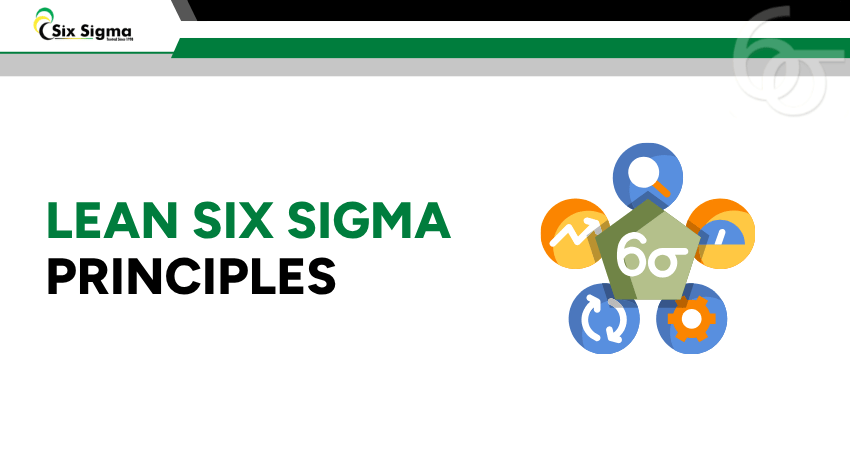
Lean Six Sigma follows core principles that help organisations improve processes, eliminate waste and deliver greater value to customers. The five principles of Lean Six Sigma include:
a) Define Value
b) Map the Value Stream
c) Create Flow
d) Establish Pull
e) Pursue Perfection


Thank You For Your Enquiry.
Our representative will get in touch with you shortly. You can also:Call Us: +442036084550
Email Us: info@sixsigma.co.uk



 Home
Home