
Call us:
+442036084550
Monday-Sunday (24 Hours)


 2026-06-13
James Smith
Every small failure starts with a warning sign, but not every organisation notices it in time. A minor design flaw, process gap, or overlooked risk can quickly lead to costly delays, quality issues, safety concerns, or operational failures. This is where Failure Mode and Effects Analysis (FMEA) becomes a valuable risk management tool.
From manufacturing and healthcare to IT and engineering, it is widely used to prevent problems before they occur. In this blog, we will explore its different types, working process, benefits, and real-world examples. Let’s get started!
Failure Mode and Effects Analysis (FMEA) is a structured risk assessment method used to identify potential failures in a product, process, or system before they create operational problems. It helps organisations analyse the impact of failures and implement preventive actions to improve quality, safety, reliability, and performance.
FMEA strengthens engineering and operational practices by enabling Cross-functional Teams (CFTs) to assess risks collaboratively during the design, development, or improvement stages. By identifying and prioritising potential failure modes early, organisations can improve reliability, reduce defects and waste, and support continuous improvement across operations.
FMEA is commonly used during operational planning to reduce the likelihood of defects and disruptions. Below are some situations where FMEA is commonly used:
1) Before Launching a New Product or Process: Helps identify potential failure points before implementation or production begins.
2) When Improving an Existing Process: Supports continuous improvement by analysing recurring issues, inefficiencies, defects, and opportunities for efficiency improvement.
3) During Process or Design Changes: Useful when materials, equipment, workflows, or system requirements are modified.
4) To Reduce Quality and Safety Risks: Assists teams in preventing failures that may impact customers, compliance, or operational reliability.
5) When Customer Complaints or Failures Increase: Helps uncover root causes behind defects, downtime, or performance issues.
6) For Preventive Risk Management: Enables organisations to proactively prioritise and control high-risk failure modes before they escalate.
7) During Cross-functional Reviews and Planning: Encourages collaboration between engineering, operations, quality, and maintenance teams to improve decision-making.
8) For Ongoing Evaluation of Products or Services: FMEA can be revisited regularly to assess risks as processes, technologies, or business needs evolve.
Different types of Failure Mode and Effects Analysis (FMEA) help organisations detect failures early and take corrective actions before issues become critical. The main types are explained below:
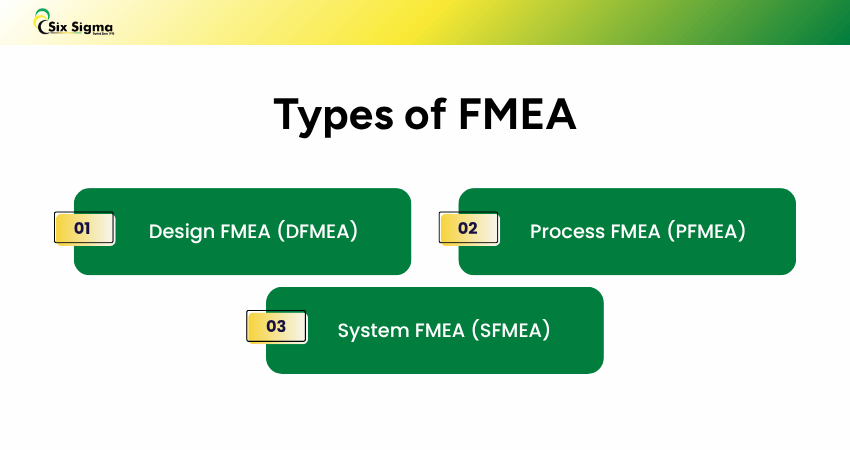
Design FMEA focuses on evaluating risks within a product or system design before production begins. It helps engineering teams assess how design flaws, material selection, or component weaknesses may affect product performance, safety, and customer satisfaction.
Process FMEA is used to analyse risks within manufacturing, assembly, or operational processes. It helps organisations identify process-related issues that may lead to defects, delays, waste, or inconsistent production outputs.
System FMEA examines how failures within interconnected systems or subsystems can affect overall system functionality. It is commonly used in complex industries such as automotive, aerospace, and IT systems.
Learn Lean Six Sigma techniques to lead effective process improvement initiatives with the Lean Six Sigma Green Belt Training – Join today!
Failure Mode and Effects Analysis (FMEA) involves systematically identifying potential failures in a process or product and evaluating their impact to prioritise corrective actions. The following steps explain how to perform FMEA effectively:
Start by creating a cross-functional team with members from different departments. This may include professionals from engineering, quality assurance, operations, maintenance, and production. A diverse team brings different perspectives and helps identify risks more effectively. Team collaboration also improves decision-making during the analysis process.
Define the exact process, product, system, or service that will be analysed. A clear scope helps the team stay focused and prevents unnecessary complexity. This step also determines the boundaries, objectives, and risk areas that require evaluation, ensuring a more structured and efficient FMEA process.
Gather all relevant information related to the process or product being analysed. This may include process maps, design documents, customer feedback, maintenance reports, and historical failure data. Accurate information improves the quality of the analysis and helps teams make informed decisions.
List the functions and expected performance requirements of the product, process, or system within the defined scope. Understanding how each function should operate helps teams identify where failures may occur and creates a strong foundation for analysing potential risks and weaknesses.
Determine the possible ways a process, product, or system could fail. These are known as failure modes. The team should identify issues that may affect quality, safety, reliability, customer satisfaction, or operational performance. This allows teams to address risks before they develop into larger operational problems.
Analyse the effects of each potential failure. This step helps teams understand how failures may impact customers, operations, safety, costs, or compliance. Understanding these consequences allows teams to prioritise critical risks more effectively while supporting better decision-making during risk assessments.
Evaluate the severity of each failure and identify its root causes. Teams often assess risks based on severity, occurrence, and detection to determine which failures require immediate action. Root cause analysis supports corrective actions that reduce future risks and improve overall reliability.
Examples of FMEA show how organisations use the method to reduce risks and improve operational performance across different industries. Here are two practical FMEA examples:
A pharmaceutical manufacturer used Process FMEA (PFMEA) to evaluate risks in its tablet packaging process. The study identified issues such as incomplete sealing and package deformation caused by incorrect sealing temperatures and timing.
After assessing the severity and likelihood of these failures, the company implemented temperature monitoring systems and visual timing controls to reduce packaging defects and enhance product safety.
An automotive manufacturer applied Process FMEA (PFMEA) to assess risks in its brake assembly process. The study identified issues such as incorrect brake pad installation, sensor malfunction, and hydraulic leakage that could affect vehicle safety and braking performance.
To reduce these risks, the company introduced automated inspections, operator training, and real-time monitoring measures. These improvements helped strengthen quality assurance, reduce failures, and improve operational reliability.
Improve Processes with Confidence with the Lean Six Sigma Yellow Belt Training – Register now!
FMEA is widely used across industries to identify potential failures, reduce risks, and improve operational reliability. Below are some real-world applications of FMEA:
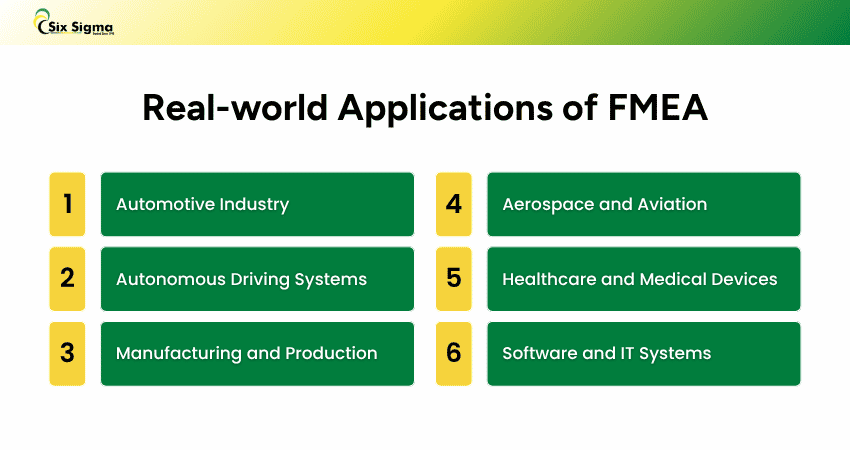
Automotive manufacturers use FMEA to improve vehicle safety, reliability, and production quality. It allows teams to identify potential failures in braking systems, electronics, vehicle components, and manufacturing processes before they affect customers. FMEA also supports compliance with automotive safety standards and helps reduce costly recalls.
Companies developing autonomous driving technologies use FMEA to assess risks within sensors, software, navigation systems, and safety controls. By identifying possible failures early, organisations can improve vehicle performance, strengthen passenger safety, and reduce operational risks in autonomous transportation systems.
Manufacturing industries use FMEA to improve process efficiency and reduce production defects. It helps teams identify weaknesses in workflows, machinery, assembly lines, and quality control systems, leading to lower downtime, reduced waste, and more consistent product quality.
FMEA plays a critical role in the aerospace and aviation industries, where safety and reliability are essential. Engineers use it to assess potential failures in aircraft systems, engines, navigation equipment, and maintenance operations to improve passenger safety and reduce operational risks.
Healthcare organisations and medical device manufacturers use FMEA to improve patient safety and reduce clinical risks. It helps identify potential failures in medical equipment, healthcare procedures, and patient care systems before they result in harmful outcomes and affect overall healthcare service quality.
Software development and IT teams use FMEA to identify risks related to system performance, cybersecurity, software failures, and data management. This contributes to improved system stability, reduced service disruptions, and more reliable digital operations across modern business environments.
FMEA software helps organisations improve risk management, reduce operational issues, and enhance process efficiency. Below are some key benefits of using it:
FMEA software helps organisations identify potential failures early in the design or process stage. This reduces costly rework, product recalls, downtime, and operational disruptions. By addressing issues before they escalate, businesses can improve efficiency while lowering maintenance and production costs.
FMEA software helps teams detect risks that may affect system reliability or workplace safety. It supports proactive risk assessment and allows organisations to implement corrective actions before failures occur. This strengthens operational consistency and helps prevent safety-related incidents.
Using FMEA software allows organisations to identify defects and quality issues during product development or process planning. This leads to more consistent outputs, improved customer satisfaction, and better overall product performance. It also supports long-term continuous quality improvement initiatives.
FMEA software provides a structured approach for identifying, analysing, and prioritising risks. It enables teams to focus on high-risk failure modes and implement preventive actions more efficiently. This improves decision-making and creates a stronger risk management process across operations.
Many industries must follow strict quality and safety regulations. FMEA software helps organisations maintain compliance by documenting risk assessments, corrective actions, and process controls. This improves audit readiness while supporting industry standards and regulatory requirements.
FMEA software centralises risk analysis data, making documentation easier to manage and update. Teams can track changes, maintain consistency, and improve collaboration across departments. Better documentation also supports knowledge sharing and long-term operational improvement.
Upgrade Your Six Sigma Expertise with the Lean Six Sigma Black Belt Upgrade Training – Join now!
Failure Mode and Effects Analysis (FMEA) offers several benefits in risk management, but it also has certain limitations organisations should consider during implementation. Understanding these challenges helps teams apply the method more effectively:
1) Time Consuming Process: FMEA requires detailed analysis, collaboration, and regular reviews, which can take significant time and resources.
2) Depends on Team Expertise: The quality of FMEA results depends heavily on the experience and knowledge of the team performing the analysis.
3) May Not Predict Every Failure: Some complex or unexpected failures can still be overlooked, especially in highly interconnected systems.
4) Requires Accurate Data: Incomplete or incorrect data can reduce the accuracy of risk assessments and lead to ineffective decisions.
5) Needs Regular Updates: FMEA must be continuously reviewed as processes, technologies, or products change over time.
6) Can Become Complex for Large Systems: Large-scale operations or systems may generate extensive failure data, making analysis difficult to manage.
7) Focuses Mainly on Known Risks: FMEA is more effective at identifying known or anticipated failures rather than completely new or unpredictable risks.
8) Does Not Eliminate Risk Completely: FMEA helps reduce and prioritise risks, but it cannot guarantee that all failures will be prevented.
Failure Mode and Effects Analysis (FMEA) helps organisations identify and address potential risks before they lead to costly failures, safety concerns, or operational disruptions. By improving reliability, product quality, and process efficiency, it supports proactive decision-making, continuous improvement, and stronger operational performance across various industries.
Build practical Lean Six Sigma expertise for smarter business decision-making with the Lean Six Sigma Training – Join now!


Thank You For Your Enquiry.
Our representative will get in touch with you shortly. You can also:Call Us: +442036084550
Email Us: info@sixsigma.co.uk



 Home
Home