

Call us:
+442036084550
Monday-Sunday (24 Hours)


 2026-05-30
James Smith

Have you ever solved a problem at work, only to see it happen again a few days later? From repeated system failures to customer complaints and operational delays, many business problems return because only the symptoms are fixed, not the actual cause. This is where Root Cause Analysis (RCA) makes a real difference by helping organisations identify the true source of issues instead of relying on temporary fixes.
Whether it is a manufacturing defect, an IT issue, or a workflow problem, Root Cause Analysis helps businesses solve issues and prevent recurrence. It improves decision-making and supports long-term business improvement. In this blog, you will explore the steps of RCA, its techniques, benefits, and applications. Read on to learn more!
Root Cause Analysis (RCA) is a systematic problem-solving method used to identify the main underlying reason behind a problem, defect, or failure. Instead of only fixing temporary symptoms, RCA focuses on finding the actual root cause, so organisations can apply long-term solutions and prevent the issue from recurring.
For example, if a machine repeatedly breaks down, simply repairing it may not solve the problem permanently. RCA helps identify deeper causes such as poor maintenance, faulty parts, or process gaps. It is widely used across industries to improve quality, reduce risks, and support continuous improvement.

Root Cause Analysis helps organisations identify the actual source of problems instead of applying temporary fixes. It reduces recurring issues and supports better business performance. Key reasons why RCA is important include:
1) Prevents Recurrence: Addressing the root cause helps organisations implement long-term solutions that stop the same problems from occurring repeatedly.
2) mproves Processes: By identifying where and how issues originate, businesses can improve workflows, remove inefficiencies, and support continuous improvement.
3) Reduces Costs: Eliminating the actual cause of problems reduces downtime, repair costs, operational waste, and the need for repeated temporary fixes.
4) Enhances Safety and Risk Management: In industries such as manufacturing and healthcare, RCA helps identify hidden risks and creates safer, more reliable processes.
5) Fosters Accountability: Focusing on processes and underlying causes instead of blaming individuals encourages a more transparent and improvement-focused work culture.
Root Cause Analysis follows a structured approach to identify the actual reason behind a problem instead of only fixing its symptoms. It helps organisations analyse issues systematically and implement long-term corrective actions. Some key concepts involved in RCA include:
RCA commonly investigates problems through two perspectives known as the Data Door and the Process Door. Both approaches help identify contributing factors and are suitable for different types of projects. These approaches can be understood as follows:
The Data Door focuses on analysing facts, measurements, trends, reports, and statistical data to identify the root cause accurately and systematically. This approach is commonly used in effectiveness projects where organisations aim to improve results, quality, or performance outcomes. It enables teams to rely on objective evidence rather than assumptions, leading to more accurate and reliable conclusions.
The Process Door focuses on examining workflows, operational steps, and procedures to identify inefficiencies or process gaps within business operations. This approach is more suitable for efficiency projects where the objective is to improve productivity, reduce waste, or streamline operations. This perspective helps organisations optimise workflows and improve overall operational efficiency.
The Open-Narrow-Close approach is a structured RCA method used to identify and validate the actual root cause of a problem. It helps teams organise their analysis systematically and improve decision-making. This approach mainly consists of the following phases:
The Open Phase focuses on generating as many possible causes as possible. Teams commonly use brainstorming sessions to collect ideas and encourage creative thinking. These ideas are then organised using tools such as the Fishbone Diagram, which helps categorise and visualise possible causes of the problem.
In the Narrow Phase, the team analyses the possible causes identified earlier and narrows the list to the most likely root causes. Techniques such as multivoting, Fishbone Diagrams, and cause-and-effect analysis help teams prioritise the causes that require further investigation and validation. It allows teams to focus their efforts on the most impactful issues, improving efficiency in problem-solving.
In the Close Phase, the team validates the identified root causes using data collection, regression analysis, hypothesis testing, or Design of Experiments (DOE). Once the causes are confirmed, appropriate corrective actions are implemented to eliminate the issue and prevent recurrence.
Develop leadership skills for driving large-scale process improvement initiatives with the Lean Six Sigma Black Belt Training – Register now!
RCA uses various techniques and tools to identify, analyse, and validate the actual causes of problems. These tools help organisations approach problems logically, improve accuracy, and implement effective solutions. Some commonly used Root Cause Analysis tools and techniques include:
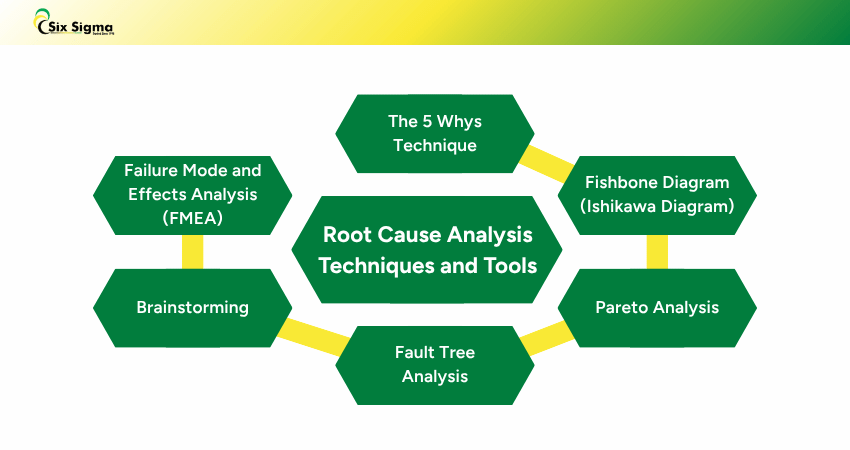
The 5 Whys Technique is a simple problem-solving method that helps identify the root cause of an issue by repeatedly asking “Why?” until the actual cause is discovered. Each answer forms the basis for the next question, allowing teams to investigate deeper layers of the problem. This technique is widely used for identifying process issues, operational failures, and recurring problems.
The Fishbone Diagram, also known as the Ishikawa Diagram or Cause-and-Effect Diagram, helps teams visually organise possible causes of a problem into different categories. The structure resembles a fish skeleton, where the problem appears at the head and possible causes branch out like bones. Common categories include people, processes, equipment, materials, and environment.
Pareto Analysis is based on the Pareto Principle, also known as the 80/20 rule, which suggests that a small number of causes are often responsible for most problems. This technique helps organisations prioritise the most significant issues by identifying the causes that create the greatest impact. Pareto charts are commonly used to analyse defects, complaints, or operational failures.
Fault Tree Analysis is a structured technique used to identify the possible causes of system failures or operational issues. It starts with the main problem and breaks it down into smaller contributing factors using a tree-like diagram. This method is commonly used in engineering, manufacturing, healthcare, and safety management to analyse complex failures and reduce risks.
Brainstorming is a collaborative technique used to generate a large number of ideas and possible causes related to a problem. Team members openly share suggestions without immediate criticism or judgement, encouraging creativity and wider participation. Brainstorming is often combined with tools such as Fishbone Diagrams to organise and analyse ideas effectively.
Failure Mode and Effects Analysis (FMEA) is a proactive risk assessment technique used to identify possible failures within a process, product, or system and evaluate their potential impact on business operations effectively. Teams analyse the severity, occurrence, and detection of possible failures to prioritise risks and implement preventive actions before problems occur.
Start your process improvement journey with the Lean Six Sigma Yellow Belt Training – Register now!
Root Cause Analysis follows a structured approach to identify the actual source of a problem and implement long-term solutions. Some common steps involved in performing RCA include:
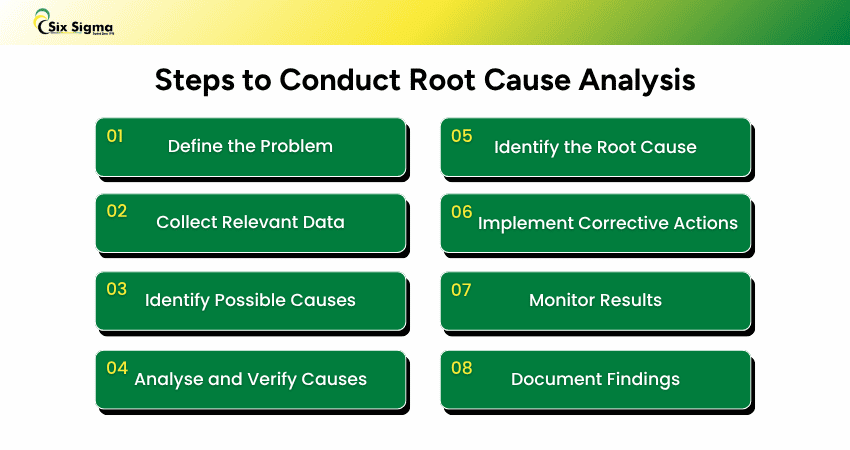
1) Define the Problem: Clearly identify the issue, its impact, and where or when it occurs.
2) Collect Relevant Data: Gather reports, observations, records, and other information related to the problem.
3) Identify Possible Causes: Use RCA tools such as brainstorming, Fishbone Diagrams, or the 5 Whys Technique to identify potential causes.
4) Analyse and Verify Causes: Evaluate the possible causes carefully and validate them using evidence and data.
5) Identify the Root Cause: Determine the actual underlying reason responsible for the problem.
6) Implement Corrective Actions: Develop and apply solutions to eliminate or control the root cause.
7) Monitor Results: Track the effectiveness of corrective actions to ensure the issue does not recur.
8) Document Findings: Record the analysis, solutions, and outcomes for future reference and continuous improvement.
Consider a company called ABC Manufacturing that experienced an increase in defective products and customer complaints. To identify and resolve the issue effectively, the team used RCA within the DMAIC methodology through the following stages:
1) Define Phase: ABC Manufacturing identified the main problem as a 15% increase in defective products during the last quarter.
2) Measure Phase: The team collected production reports, machine performance records, and quality inspection data to understand when and where defects were occurring.
3) Analyse Phase: Using RCA tools such as the Fishbone Diagram and the 5 Whys Technique, the team discovered that incorrect machine calibration was the primary root cause of the defects.
4) Improve Phase: The company introduced regular machine calibration schedules, employee training sessions, and updated maintenance procedures to address the issue.
5) Control Phase: ABC Manufacturing continuously monitored production quality and machine performance to ensure the defect rate remained low and the problem did not recur.
Learn proven techniques to drive continuous process improvement successfully with the Lean Six Sigma Green Belt Training – Join today!
Root Cause Analysis helps organisations eliminate the actual cause of problems and improve operational performance. Some key benefits of RCA include:
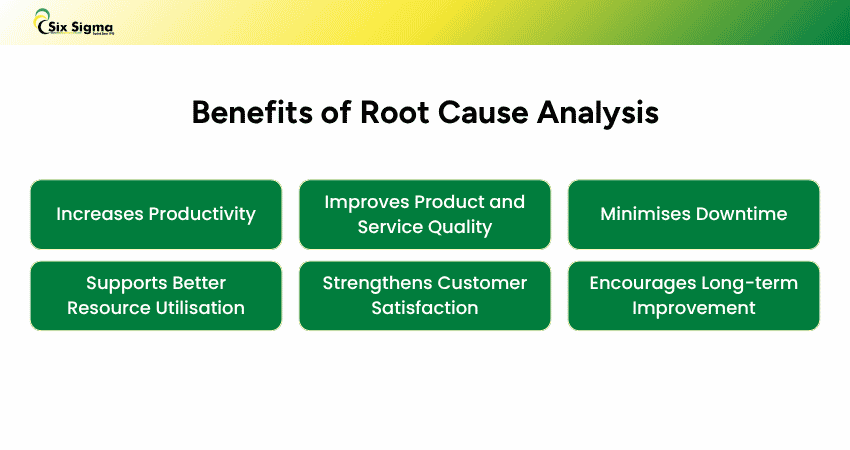
1) Increases Productivity: RCA helps reduce operational disruptions and improves workflow efficiency, allowing teams to work more effectively.
2) Improves Product and Service Quality: Identifying the causes of defects or failures helps organisations maintain higher quality standards.
3) Minimises Downtime: RCA helps organisations prevent repeated failures that may interrupt operations or production activities.
4) Supports Better Resource Utilisation: Eliminating recurring problems reduces wasted time, effort, and operational resources.
5) Strengthens Customer Satisfaction: Improved quality and fewer recurring issues help businesses deliver better customer experiences.
6) Encourages Long-term Improvement: RCA promotes continuous learning and process optimisation across the organisation.
Although Root Cause Analysis is highly effective, certain mistakes can reduce its accuracy and effectiveness. Some common RCA pitfalls and ways to avoid them include:
1) Focusing Only on Symptoms: Some teams solve only the visible issue without identifying the actual root cause. This can cause the problem to recur repeatedly.
How to Avoid It: Investigate deeper causes using RCA tools such as the 5 Whys or Fishbone Diagram.
2) Jumping to Conclusions: Making assumptions without proper evidence may result in incorrect decisions.
How to Avoid It: Use accurate data, observations, and analysis before identifying the root cause.
3) Poor Data Collection: Incomplete or inaccurate information can weaken the RCA process and affect results.
How to Avoid It: Collect detailed and reliable data from multiple sources.
4) Blaming Individuals Instead of Processes: Focusing on people instead of process failures may discourage open discussion and collaboration.
How to Avoid It: Concentrate on improving systems, workflows, and operational processes rather than assigning blame.
5) Ignoring Follow-up Actions: Some organisations fail to monitor whether corrective actions are effective after implementation.
How to Avoid It: Continuously track performance and review results to ensure the problem does not recur.
Problems rarely disappear with temporary fixes alone. Root Cause Analysis helps organisations identify the real causes behind issues, enabling long-term solutions and preventing recurrence. By using effective RCA tools and techniques, businesses can improve efficiency, reduce risks, strengthen processes, and support continuous improvement across operations.
Learn proven techniques to improve quality, efficiency, and business performance with the Lean Six Sigma Training – Join now!


Thank You For Your Enquiry.
Our representative will get in touch with you shortly. You can also:Call Us: +442036084550
Email Us: [email protected]



 Home
Home