
Call us:
+442036084550
Monday-Sunday (24 Hours)


 2026-06-13
James Smith

Do different teams in your organisation have different views of the same process? When people understand a process differently, it can lead to confusion, communication gaps, delays and inconsistent results. This is a common challenge in many businesses and a SIPOC Diagram can help solve this problem.
This diagram allows teams to see how a process works from start to finish and develop a shared understanding of the workflow. In this blog, we will explore what is a SIPOC Diagram, what it is used for and how to create one to help your business achieve consistent results. Let’s dive in!
A SIPOC Diagram is a visual process mapping tool that summarises the key elements of a business process. This includes identifying Suppliers, Inputs, Process, Outputs and Customers involved in a process. By identifying these elements, organisations can gain a clear understanding of how work flows through a process and who is involved at each stage.
Rather than focusing on detailed activities, a SIPOC Diagram provides a high-level overview of a process from start to finish. Because of its simplicity, it is widely used in process improvement initiatives, Lean and Six Sigma projects to support better decision-making and improve overall process performance.

The term SIPOC represents the five key elements of a business process such as Suppliers, Inputs, Process, Outputs and Customers. Understanding each element of SIPOC is essential for creating an effective process map and identifying opportunities for improvement. Here's what each of them focuses on:
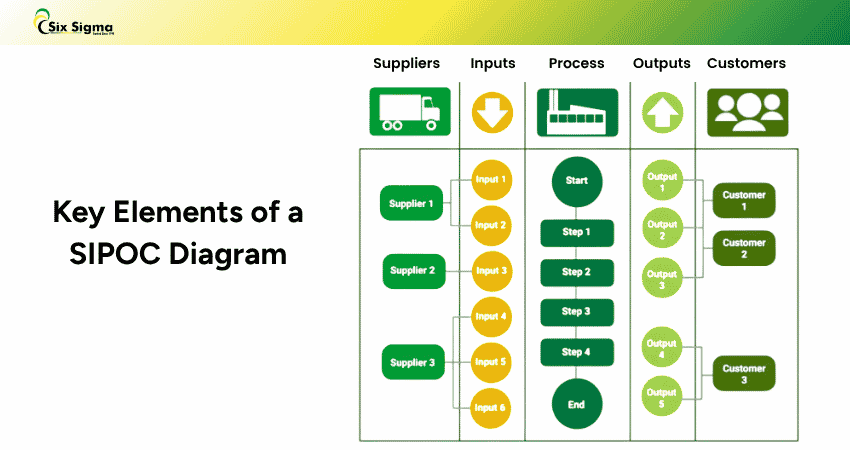
Suppliers are the individuals, departments, organisations, or systems that provide the resources needed to perform a process. These resources can include information, materials, equipment, or services.
For example, in a manufacturing company, raw material vendors may act as suppliers. In an HR recruitment process, job applicants and recruitment agencies can be considered suppliers.
Inputs are the resources required to complete a process. These may include data, materials, documents, tools, technology or Human Resources (HR). Without the correct inputs, a process cannot deliver the desired outputs.
Examples of inputs include customer orders, raw materials, software systems, employee information and operational guidelines.
The process refers to the sequence of high-level activities that transform inputs into outputs. In a SIPOC Diagram, the process is usually represented using five to seven major steps. The purpose is to provide an overview that helps stakeholders understand the workflow.
For example, in an online order fulfilment process, the main steps may include receiving the order, verifying payment, preparing the product, shipping the order and confirming delivery.
Outputs are the products, services, information or results generated by the process. They represent the value delivered by the process and are often what customers receive. Clearly identifying outputs helps ensure that process outcomes align with customer expectations.
Examples of outputs include completed products, approved applications, reports, invoices or customer support resolutions.
Customers are the individuals, groups or organisations that receive the outputs generated by the process. Customers may be external, such as paying clients, or internal, such as another department within the organisation.
For example, in a product delivery process, the customer may be the person who purchased the product. In an internal reporting process, the customer could be the management team that uses the report for decision-making.
A SIPOC Diagram is used to gain a high-level understanding of a process before conducting detailed analysis or implementing improvements. Since SIPOC Diagrams focus on the overall process rather than detailed activities, they are useful for analysing and improving business processes.
They are particularly valuable in manufacturing and customer-facing environments where reducing defects, improving consistency, and enhancing process performance are important objectives.
Equip yourself with the tools needed to increase process efficiency with Six Sigma Green Belt Training – Register today!
Creating a SIPOC Diagram is a straightforward process when approached step by step. The following seven steps provide a structured approach to creating an effective SIPOC Diagram. Following these steps helps teams clearly understand processes and improve overall efficiency.
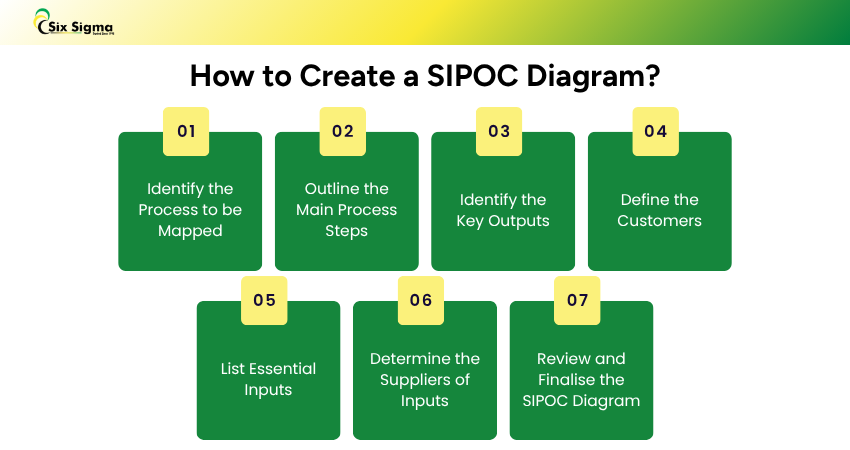
The first step is to clearly define the process you want to analyse. Determine the starting point and ending point of the process. Clearly defining process boundaries prevents confusion and keeps the diagram focused. This clarity ensures that all team members understand the scope of the process from the beginning.
Next, you need to identify the major process activities that transform inputs into outputs. A SIPOC Diagram should contain only the high-level steps rather than detailed sub-processes. Most diagrams include between five and seven process stages. Focusing on key steps helps maintain simplicity and improves overall understanding.
After outlining the process steps, you need to determine the outputs produced by the process. Outputs are the products, services, information or results generated once the process is completed. These outputs represent the value delivered to customers and should align with their needs and expectations.
Now, you can determine who receives the outputs. Customers are the individuals, groups, departments or organisations that benefit from the results produced by the process. They can be external customers, such as clients purchasing a product or service, or internal customers, such as teams that rely on information or resources from another department.
Once the customers and outputs have been identified, the next step is to list the essential inputs required for the process. Inputs are the resources, materials, tools or systems needed to complete the process and produce the desired outputs. Without the right inputs, the process cannot function effectively. Accurate input identification ensures the process is well-supported and efficient.
Here, you need to identify where the inputs come from. Suppliers are the individuals, departments, organisations or systems that provide the resources needed for the process. Understanding who supplies the inputs helps teams recognise dependencies and ensure that the process has everything required to operate efficiently.
The final step is to review the completed SIPOC Diagram with relevant stakeholders and team members. This ensures that all details have been accurately identified and that the diagram reflects the actual process. Any missing information, inconsistencies or unclear areas should be addressed at this stage. A thorough review ensures accuracy and improves the effectiveness of the final diagram.
SIPOC Diagrams offer several benefits for organisations looking to understand, analyse and improve their business processes. Let's check the benefits gained from using this diagram:
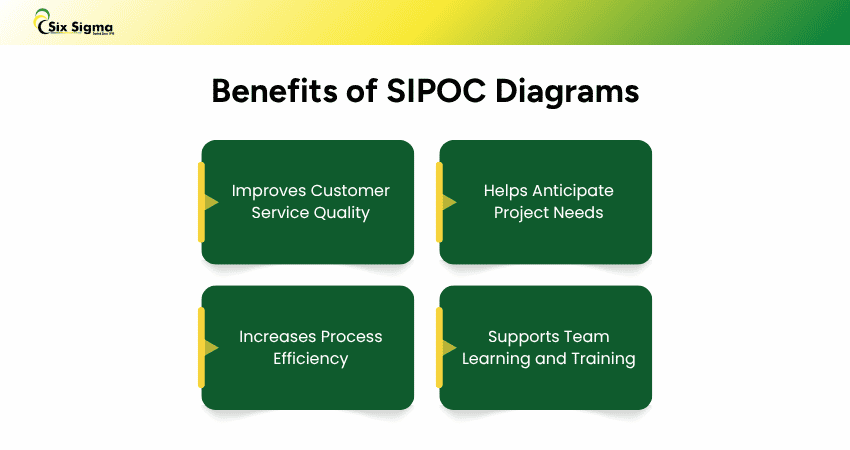
A SIPOC Diagram helps businesses understand who their customers are and what outputs they expect from a process. By clearly identifying customer requirements and process outcomes, teams can ensure that products and services consistently meet expectations. This customer-centric approach can lead to higher satisfaction, fewer complaints and improved service quality.
By identifying Suppliers, Inputs, Process steps, Outputs and Customers, a SIPOC Diagram provides a complete overview of the resources and stakeholders involved in a process. This helps teams anticipate project requirements, recognise dependencies and plan effectively. As a result, organisations can reduce unexpected issues and improve project execution.
SIPOC Diagrams make it easier to understand how a process operates from start to finish. This visibility helps organisations identify bottlenecks, unnecessary activities and areas where resources may be wasted. By addressing these issues, businesses can streamline workflows, improve productivity and enhance overall process efficiency.
<H3> 4) Supports Team Learning and Training
Because SIPOC Diagrams present processes in a simple and visual format, they are valuable tools for training and knowledge sharing. New employees can quickly understand how a process works, who is involved and how different activities are connected. This helps improve onboarding, encourages collaboration and ensures a consistent understanding of business processes across teams.
Build confidence in applying Six Sigma tools and techniques with Six Sigma Yellow Belt Training – Sign up soon!
A SIPOC Diagram is effective when it accurately represents the process while remaining simple and easy to understand. Following a few best practices can help ensure that the diagram provides meaningful insights. Below are some of the practices you can consider implementing:
Creating a SIPOC Diagram should be a collaborative effort involving the people who understand the process best. Bringing together team members from different departments allows organisations to gather accurate information, identify potential gaps and ensure that all perspectives are considered. Whether conducted in person or virtually, collaboration helps create a more complete and reliable process map.
A SIPOC Diagram is designed to provide a high-level overview of a process, so each section should remain brief and focused. Avoid including excessive details or lengthy descriptions, as this can make the diagram difficult to understand. Keeping information concise helps stakeholders quickly grasp the key elements of the process.
The purpose of a SIPOC Diagram is to summarise a process rather than document every activity involved. Focus on the major process steps and essential information instead of detailed tasks or decision points. Maintaining a high-level perspective keeps the diagram simple, clear and effective for process analysis.
Before finalising the SIPOC Diagram, share it with stakeholders and team members for review. Feedback can help identify missing information, correct inaccuracies and ensure the diagram accurately represents the process. A collaborative review also helps build agreement and understanding among everyone involved.
Any uncertainties or gaps identified during the review process should be resolved before the diagram is finalised. Clarifying unclear process steps, inputs, outputs or stakeholder roles improves the accuracy and usefulness of the SIPOC Diagram. A well-defined diagram provides a stronger foundation for process improvement and decision-making.
To better understand how a SIPOC Diagram works, consider an online order fulfilment process. Here is how you can create your diagram for this scenario:
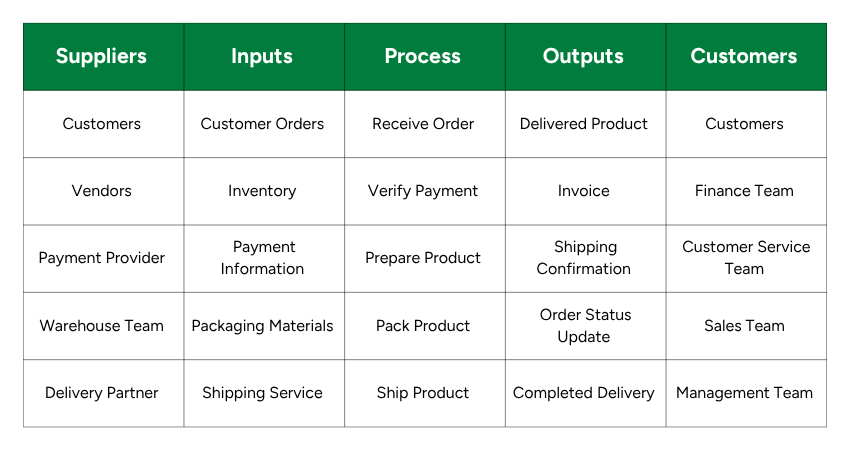
This example demonstrates how a SIPOC Diagram provides a clear overview of how inputs are transformed into outputs while highlighting the relationships between suppliers and customers.
A SIPOC Diagram is one of the most effective tools for understanding and improving business processes. Whether used in Lean Six Sigma projects, process improvement initiatives or day-to-day operations, it helps organisations create efficient and consistent workflows. By providing a clear process overview, it enables teams to understand how work flows through a process and identify areas for improvement.
Learn how to identify inefficiencies and optimise business processes with Six Sigma Training – Join now!


Thank You For Your Enquiry.
Our representative will get in touch with you shortly. You can also:Call Us: +442036084550
Email Us: info@sixsigma.co.uk



 Home
Home