

Call us:
+442036084550
Monday-Sunday (24 Hours)


 2026-06-27
James Smith
Every product or service that stands out has one thing in common: it delivers exactly what customers care about most. That’s where CTQ comes in. Critical to Quality (CTQ) helps bridge the gap between customer expectations and measurable outcomes by turning vague needs into clear, actionable standards.
So, Critical to Quality can tell you the whole story of why some products and services consistently exceed customer expectations while others fall short. In this blog, we’ll break down what CTQ really means, why it matters and a practical example to help you apply it effectively. So read on!
Critical to Quality (CTQ) refers to the specific features, requirements, or characteristics of a product or service that matter most to customers and directly influence customer satisfaction. These are measurable aspects that help organisations understand what truly adds value and where improvements are needed.
To identify CTQs, organisations gather the Voice of the Customer (VOC) and translate customer needs into clear, measurable quality requirements and performance standards. By consistently monitoring and meeting these standards, organisations can drive targeted process improvements, reduce defects, and ensure that outputs reliably align with customer expectations.

Critical to Quality (CTQ) helps organisations tackle common challenges such as inefficient processes, unclear objectives and inconsistent customer experiences. It shifts the focus toward maintaining the key product and service characteristics that attract most customers and keep them coming back.
In essence, CTQs are the foundation of Quality Management. They turn customer expectations into measurable standards using data and metrics. By aligning products and processes with what customers actually value, CTQs help drive more sustainable business growth.
CTQs have a few important qualities that make them effective in ensuring product and process quality. These include:
1) Measurable: CTQs are always quantifiable. They rely on metrics that can be tracked and compared against standards, allowing teams to evaluate performance objectively.
2) Customer-focused: CTQs are based on real customer needs and expectations, not assumptions. They are identified through the Voice of the Customer (VoC) to ensure they truly reflect what matters most.
3) Prioritised: Not all CTQs are equally important. Those who have the greatest influence on customer requirements and quality outcomes should receive the highest level of attention.
4) Clear and Specific: Each CTQ is well-defined and easy to understand. This helps avoid confusion and makes it easier to set clear goals and take the right actions.
5) Actionable: CTQs are directly linked to processes that can be controlled and improved. This makes it possible to take specific steps to maintain or enhance quality.
6) Business-aligned: CTQs should support the organisation’s overall goals. By improving quality, businesses boost customer satisfaction, which ultimately drives revenue and growth.
To identify CTQs for your organisation, you can follow these steps:
1) Voice of the Customer (VoC): Start by gathering customer feedback through surveys, interviews, or focus groups to understand their needs and expectations.
2) CTQ Tree: Break down broad customer requirements into specific, measurable elements using a structured diagram.
3) Prioritisation: Rank these CTQs based on how much they impact customer satisfaction and business outcomes.
4) DMAIC: Once CTQs have been identified, DMAIC can be used to improve processes and ensure CTQ requirements are consistently met. Here is what DMAIC means:
a) Define: Clearly understand what matters most to customers by collecting and analysing their feedback.
b) Measure: Set a baseline by tracking current performance using relevant data and metrics.
c) Analyse: Identify root causes of quality issues by examining the data.
d) Improve: Implement solutions that address these issues and enhance quality.
e) Control: Put systems in place to ensure that improvements are maintained over time.
Ensure continuous improvement with the Lean Six Sigma Green Belt Course. Sign up now and make a big impact with small changes!
A CTQ tree is a simple yet powerful tool used to translate customer needs into specific, measurable quality requirements. The following steps explain how to create a CTQ tree and use it to support quality improvement and customer satisfaction:
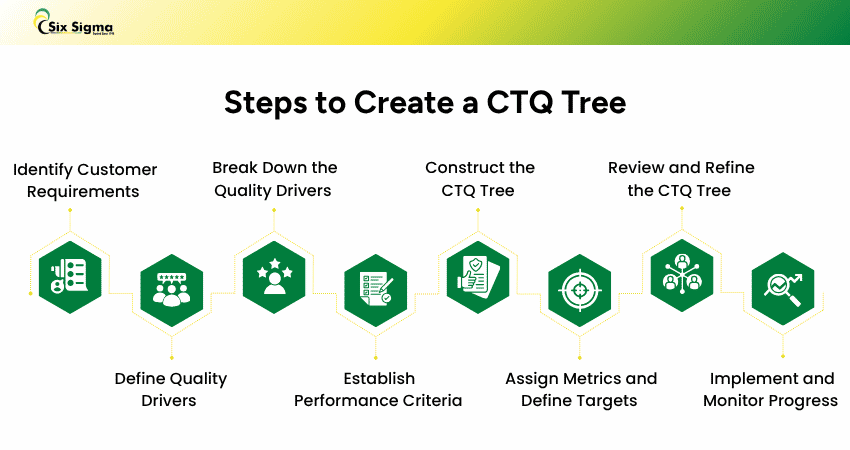
Organisations should begin by understanding what their customers actually want. You can gather this information via Voice of the Customer methods and establish a strong foundation for developing meaningful CTQs.
Next, figure out the key factors that influence customer satisfaction. These are the attributes customers care about most when evaluating your product or service.
Take each quality driver and divide it into smaller, more specific components. This helps you pinpoint exactly what contributes to the overall quality.
Once you’ve broken things down, define clear and measurable standards. These are the benchmarks your product or service needs to meet to deliver consistent quality.
Organise all of these elements into a structured, hierarchical diagram. The CTQ tree visually connects customer needs to measurable requirements, guiding your quality efforts.
For each requirement, define how it will be measured and set clear targets. Choose metrics that provide meaningful insights into performance and quality.
The CTQ tree should be reviewed with stakeholders and subject matter experts. Gather feedback to make sure it’s complete, realistic, and aligned with expectations, then adjust as needed.
Finally, integrate the CTQ tree into your processes. Track performance regularly, use the data to spot improvement areas, and take corrective actions when necessary.
Focusing on Critical to Quality elements can greatly improve how an organisation delivers value and meets customer expectations. Here are some of the key benefits of CTQ:
When CTQs are well-defined, organisations are less likely to miss customer expectations and repeat work. By using CTQ trees and clear metrics, issues can be identified early on, thus reducing rework and associated costs.
With fewer errors and less rework, teams spend far less time fixing problems and more time delivering results. This also reduces delays and improves overall workflow efficiency. As a result, projects move faster and customer satisfaction improves due to timely delivery.
CTQs help you clearly understand what customers truly value, so organisations can remove unnecessary activities and focus on what matters most. This leads to more relevant and customer-focused outcomes.
Learn the tools behind continuous improvement with the Lean Six Sigma Yellow Belt Course - Sign up now and achieve operational triumph!
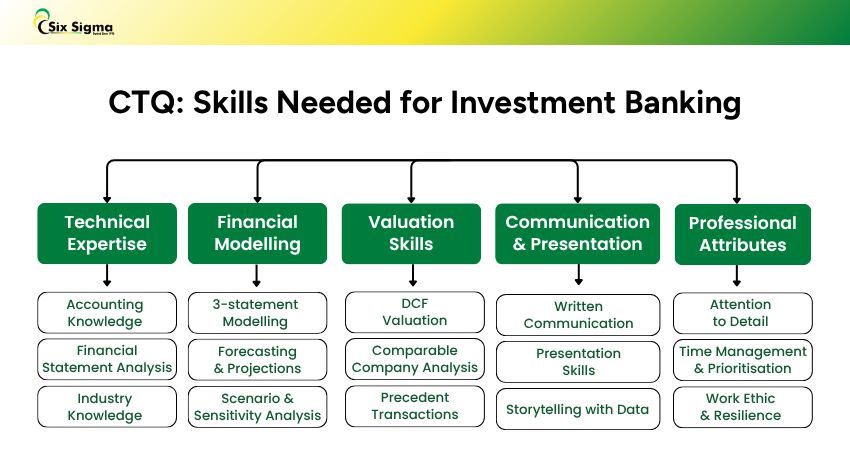
Let’s look at how a CTQ tree could work in investment banking recruitment. When financial companies hire new talent, they’re looking for people who can handle complex financial data, build accurate models, communicate clearly and perform well under pressure. Therefore, the first step is to identify the skills and competencies that are most important for success in the role.
For example, if a company is hiring entry-level Investment Bankers, they might focus on key areas like technical knowledge, financial modelling, valuation skills, communication, and professionalism. Each of these can then be broken down further into specific skills like accounting basics, Discounted Cash Flow (DCF) valuation, presentation ability and attention to detail. A CTQ tree helps organise all of this clearly, as shown below:
Understanding What is CTQ and accurately capturing CTQ elements are key to meeting (or exceeding) customer expectations while maintaining high standards. Here are some best practices to do this effectively:
1) Gather Comprehensive Data: Collect as much information as possible about customer requirements, since it’s easy to miss important details. The more data you have, the better your chances of identifying what truly matters to your customers.
2) Ask Questions in Different Ways: Rephrasing questions often helps uncover hidden needs or expectations that might not come up initially. This approach gives you deeper insights and a more complete understanding of customer priorities.
3) Use CTQ Trees to Define Metrics: CTQ trees help you turn customer needs into measurable standards that ensure quality is maintained. These metrics also allow you to quickly spot and fix issues before they negatively affect the customer experience.
4) Continuously Review and Update CTQs: Customer expectations can change over time, so it’s important to revisit and refine your CTQs regularly. This ensures your processes stay relevant and aligned with evolving customer needs.
A clear understanding of What is CTQ is a way to stay focused on what truly matters to customers. By translating expectations into clear, measurable actions, CTQ helps reduce errors and deliver real value. When applied thoughtfully, Critical to Quality successfully transforms customer insights into better outcomes and long-term business success.
Achieve unprecedented levels of operational excellence with our range of Lean Six Sigma Courses - Register now!


Thank You For Your Enquiry.
Our representative will get in touch with you shortly. You can also:Call Us: +442036084550
Email Us: info@sixsigma.co.uk



 Home
Home