
Call us:
+442036084550
Monday-Sunday (24 Hours)


 2026-06-27
James Smith
No process performs the same way every day. Whether in manufacturing, operations, or customer service, variations are inevitable. The challenge is knowing which changes are normal and which require attention. A Six Sigma Control Chart helps organisations make this distinction and maintain process consistency.
As organisations focus on quality, efficiency, and continuous improvement, data-driven decision-making has become a core part of process management. In this blog, you will learn about Six Sigma Control Charts, how they work, their types, elements, and more. Keep reading to learn how they help organisations understand process behaviour and maintain control over performance.
A Six Sigma Control Chart is a graphical tool used to monitor process performance and variation over time. It is a key part of the Six Sigma methodology, helping organisations determine whether a process is stable and operating within expected limits. The chart displays data points against a centreline and control limits to provide a clear view of process behaviour.
Also, Control Charts in Six Sigma help distinguish between common cause variation, which occurs naturally, and special cause variation, which results from unusual factors. This enables organisations to identify issues early, spot trends, and make informed decisions to improve quality and maintain process stability.

Six Sigma Control Charts work by tracking process data across a specified period and displaying it on a graph. It involves plotting process data over time against a centreline and upper and lower control limits. This allows organisations to monitor performance, identify patterns, and assess whether a process is operating within expected limits. By comparing data points against control limits, teams can quickly see if process variation remains stable or requires attention.
When all data points fall randomly within the control limits, the process is considered in statistical control and only common cause variation is present; no intervention is needed. When a data point falls outside the control limits, or when non-random patterns such as runs, trends, or cycles appear within the limits, it signals special cause variation. Teams can then investigate the root cause, take corrective action, and restore process stability.
Control Charts are used to monitor different types of process data and identify variations that may affect quality. The choice of chart depends on the type of data being analysed and the process characteristics being measured. Let's look at its key types below:
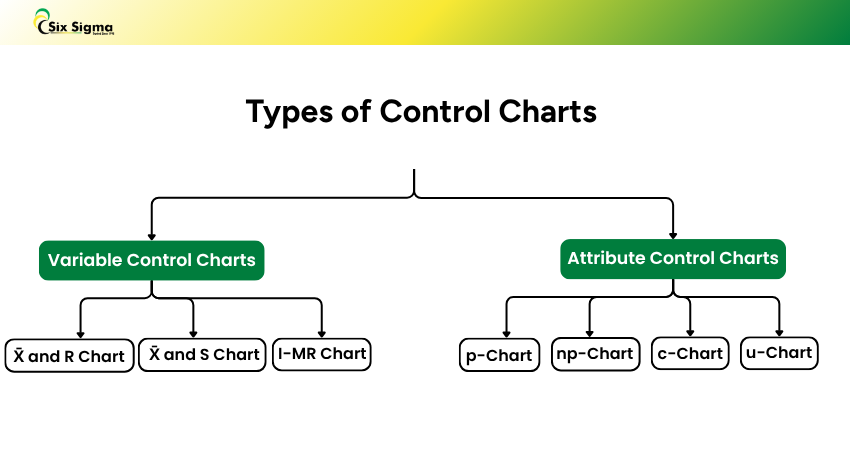
Variable Control Charts are used for continuous, measurable data such as weight, length, temperature, or time. Let’s learn its types below:
The X? and R Chart is used to monitor the average value and variability of a process when data is collected in small subgroups (typically n ? 10). The X? chart tracks changes in the process mean, while the R chart measures the range within each subgroup.
The X? and S Chart is used when subgroup sizes are larger (typically n > 10). It monitors both the process average and the standard deviation of samples, providing a more accurate measure of process variability than the X? and R Chart for larger datasets.
The Individuals and Moving Range (I-MR) Chart is used to monitor individual data points and process variation over time. It is used when data is collected as a single observation per time period, such as in batch processes, laboratory testing, or situations where measurements are costly or infrequent.
Attribute Control Charts are used for count-based or categorical data, such as the number of defects or defective items. Let’s check its types:
The p-Chart monitors the proportion or percentage of defective items in a sample. It is suitable when sample sizes vary and is commonly used to track defect rates over time.
The np-Chart tracks the actual number of defective items in a sample rather than the proportion. It is most effective when the sample size remains constant throughout the monitoring period.
The c-Chart is used to monitor the number of defects found within a single unit or item when the inspection area or sample size remains constant. It helps organisations track defect occurrence and process quality.
The u-Chart measures the average number of defects per unit when the sample size or inspection area varies. It is useful for monitoring processes where the number of opportunities for defects is not always the same.
Understanding the key elements of a Six Sigma Control Chart is essential for accurately monitoring process performance and identifying variation. Let’s look at them below:
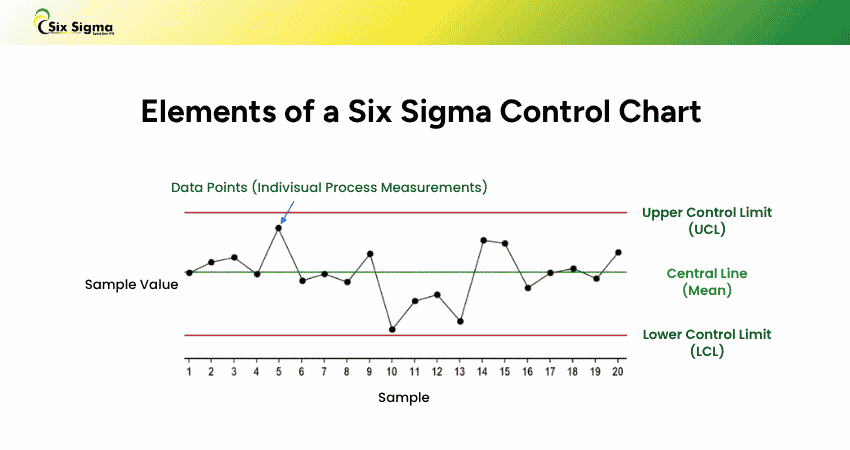
Control limits define the expected range of normal process variation. They consist of the Upper Control Limit (UCL) and Lower Control Limit (LCL), which are set at three standard deviations above and below the centre line. Generally, data within these limits indicate that the process is operating under statistical control.
Data points represent the actual process measurements collected over time and plotted on the chart. Their position relative to the centre line and control limits helps determine whether process variation is normal or requires investigation. Thus, points outside the control limits may indicate unusual variation that needs corrective action.
The centre line, also known as the mean line, represents the average value of the process being measured. It serves as a reference point for evaluating process performance and helps identify shifts or trends in the process average over time.
Learn essential tools for process improvement with the Six Sigma Yellow Belt Training – Join now!
Interpreting a Six Sigma Control Chart involves analysing data points in relation to the centre line and control limits. Let’s look at it more below:
Control Charts are used to monitor process performance over time and identify shifts or unusual changes. Data points that fall outside the control limits or any repeating or cyclical pattern in the data may indicate that the process is no longer operating under statistical control and requires investigation.
The position and distribution of data points help identify the type of variation affecting the process. Common cause variation occurs naturally within the process, while special cause variation results from specific factors that require corrective action.
Control Charts can support process capability analysis by first confirming that a process is stable and under statistical control. Once stability is established, capability metrics such as Process Capability (Cp) and Process Capability Index (Cpk) can be used to assess whether the process consistently meets performance requirements.
Control limits are typically calculated using the 3-sigma method, which uses the process mean and standard deviation to define the expected range of normal variation. These limits help determine whether a process is operating under statistical control. Let’s learn more about it below:
The Upper Control Limit (UCL) is calculated by adding three standard deviations to the process mean:

The UCL represents the highest expected level of normal process variation. Data points above this limit may indicate special cause variation and require further investigation.
The Lower Control Limit (LCL) is calculated by subtracting three standard deviations from the process mean:

The LCL represents the lowest expected level of normal process variation. Data points below this limit may signal unusual process behaviour and the need for corrective action.
Moreover, the standard deviation in the formulas above isn't usually the raw standard deviation of all individual data points. It's estimated differently depending on the chart type.
Drive strategic improvement across organisations by joining the Six Sigma Black Belt Training today!
A Six Sigma Control Chart is most useful when organisations need to monitor process performance, reduce variation, and maintain consistent quality. It provides a structured way to identify trends, detect issues, and support continuous improvement efforts. Let’s look at its use areas below:
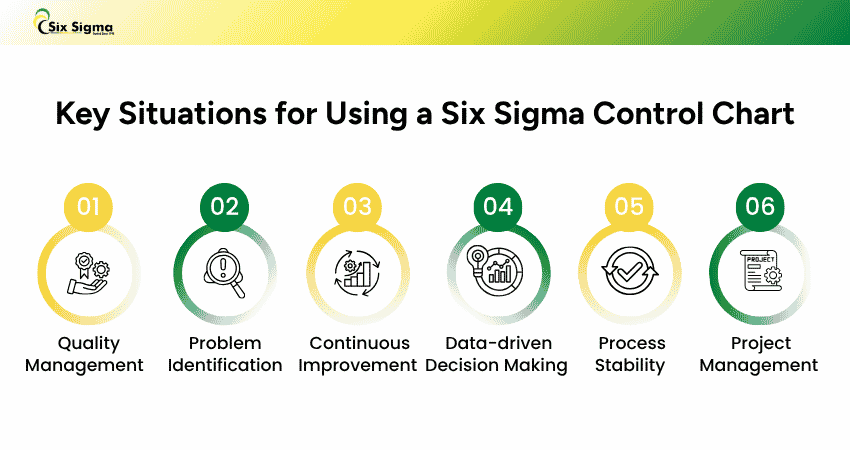
Control Charts help monitor manufacturing and service processes to ensure they consistently meet quality standards. They enable teams to identify variations that could lead to defects, errors, or customer dissatisfaction.
Control Charts in Six Sigma make it easier to identify process issues by highlighting unusual patterns or data points outside control limits. This allows organisations to investigate problems early and take corrective action before they escalate.
Six Sigma Control Charts help organisations measure the effectiveness of process improvements. By tracking performance over time, teams can determine whether changes have successfully reduced variation and improved results.
Distinguishing between the common cause and special cause variation in Control Charts supports objective decision-making. This enables teams to focus on genuine process issues rather than reacting to normal fluctuations.
Control Charts provide a visual representation of process behaviour over time. This helps organisations assess whether a process is stable, predictable, and operating within acceptable limits.
Control Charts in Six Sigma can be used to monitor process performance throughout improvement projects. Analysing trends and patterns helps project teams make informed decisions and maintain control over process outcomes.
A Six Sigma Control Chart is a powerful method for identifying variation, maintaining stability, and supporting continuous improvement. By understanding how Control Charts work and applying them effectively, organisations can make better decisions, reduce defects, and build more reliable processes.
Transform processes through data-driven improvement by signing up for the Six Sigma Training today!


The seven rules of Six Sigma are:
1) Focus on the customer
2) Understand the value stream
3) Remove waste and non-value-added activities
4) Reduce process variation
5) Make data-driven decisions
6) Involve and train employees
7) Use structured improvement methods like DMAIC or DMADV
The three Cs of Lean Six Sigma are:
1) Concern: Clearly define the problem based on facts and observed deviations
2) Cause: Identify the root cause using techniques such as the 5 Whys
3) Countermeasure: Implement corrective actions to resolve the issue


Thank You For Your Enquiry.
Our representative will get in touch with you shortly. You can also:Call Us: +442036084550
Email Us: info@sixsigma.co.uk



 Home
Home