
Call us:
+442036084550
Monday-Sunday (24 Hours)


 2026-04-13
James Smith
Choosing the right certification can feel overwhelming, especially when you are trying to grow your career but are unsure where to start. When it comes to Lean Six Sigma vs PMP, many professionals find themselves stuck between improving processes or leading projects, unsure which path will truly pay off.
To make this decision easier, understanding Lean Six Sigma vs PMP in a clear and practical way is essential. Whether you enjoy solving problems or leading teams, this blog helps you discover which path fits your strengths, interests, and long-term career goals. Let’s explore the key differences and find the path that fits you!
Lean Six Sigma is a management methodology that focuses on improving quality, performance, and customer satisfaction while reducing costs. It helps organisations achieve better results by making processes more efficient, consistent, and aligned with evolving customer needs and expectations.
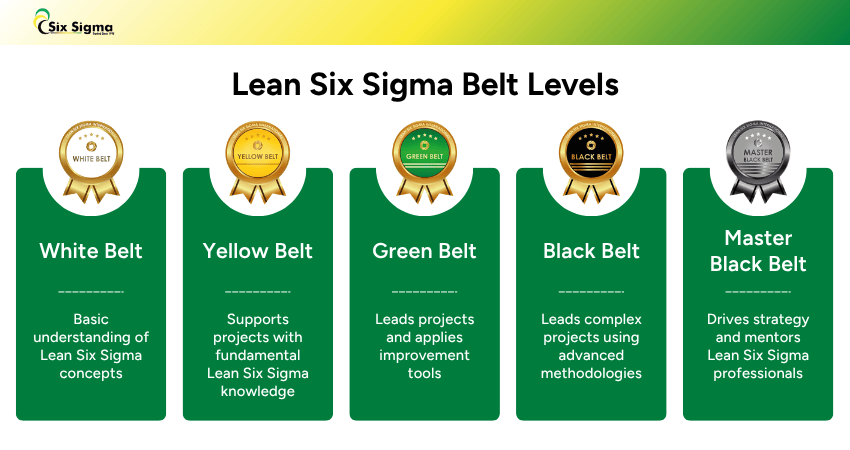
It combines Lean, which removes waste and unnecessary steps, with Six Sigma, which reduces errors and process variation. Together, they ensure that only activities adding real customer value are retained, helping organisations streamline operations and achieve continuous improvement.
PMP, or Project Management Professional, is a globally recognised certification issued by the Project Management Institute. It validates a professional’s ability to manage projects effectively and deliver successful outcomes across various industries and complex business environments worldwide.
This certification focuses on key Project Management skills such as leading teams, managing processes, and achieving business goals. PMP is widely used in industries like IT, construction, and healthcare, making it ideal for professionals aiming to build strong Project Management and leadership capabilities.
PMP and Lean Six Sigma both improve business performance but differ in focus. When comparing Lean Six Sigma vs PMP, Lean Six Sigma enhances processes, while PMP focuses on managing projects. Let’s explore their key differences:
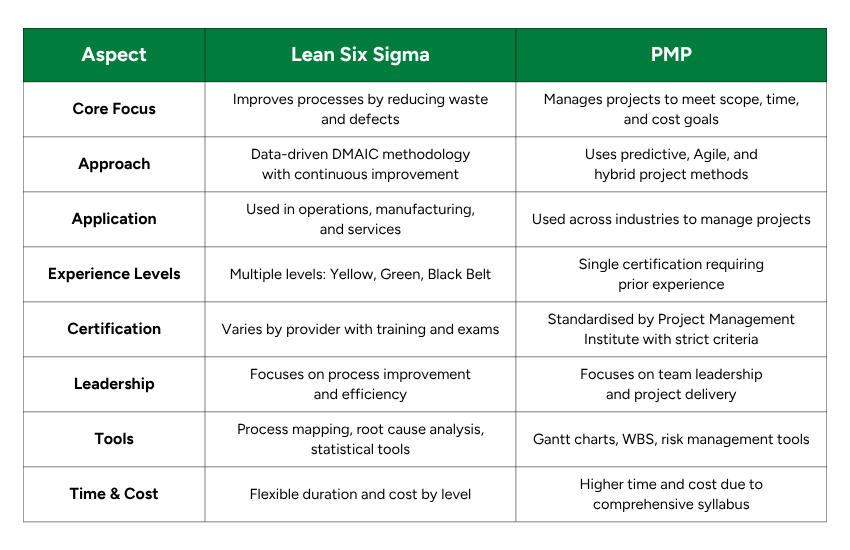
Lean Six Sigma focuses on improving processes by reducing waste and defects, aiming to enhance efficiency, quality, and customer satisfaction. It helps organisations streamline operations and achieve consistent performance through continuous improvement practices.
PMP focuses on managing projects by balancing scope, time, and cost to achieve defined outcomes. It ensures projects meet objectives, satisfy stakeholders, and deliver value through structured planning, execution, and monitoring approaches.
Lean Six Sigma uses a structured, data-driven methodology such as DMAIC to identify issues, analyse root causes, and implement improvements. It relies on statistical analysis and continuous monitoring to ensure long-term process efficiency and quality.
PMP uses established Project Management approaches, including predictive, Agile, and hybrid methods. It focuses on planning, executing, monitoring, and closing projects effectively while adapting to changing requirements and maintaining alignment with business goals.
Develop leadership skills to drive complex process improvement initiatives with the Lean Six Sigma Black Belt Training – Join now!
Lean Six Sigma is widely applied in operations, manufacturing, and service industries to enhance efficiency, reduce errors, and improve product or service quality. It supports organisations in achieving operational excellence and cost reduction.
PMP is used across various industries, including IT, construction, and healthcare, to manage projects effectively. It ensures successful delivery by coordinating resources, managing risks, and aligning project outcomes with organisational objectives.
Lean Six Sigma offers multiple certification levels, such as Yellow Belt, Green Belt, and Black Belt, allowing professionals to progress gradually. Each level builds deeper expertise in process improvement and data-driven decision-making skills.
PMP is a single certification but requires prior Project Management experience and knowledge. It is designed for professionals who have already worked on projects and want to validate and enhance their Project Management capabilities.
Lean Six Sigma certifications vary by provider and typically involve training and examinations. Requirements differ depending on the certification level, making it flexible for beginners as well as experienced professionals seeking advanced process improvement skills.
PMP follows a standardised certification process set by the Project Management Institute, including strict eligibility criteria, exam completion, and ongoing professional development to maintain certification status over time.
Lean Six Sigma professionals lead process improvement initiatives and focus on identifying inefficiencies, solving operational problems, and improving quality. Their leadership is centred on data-driven decision-making and continuous improvement within organisational processes.
PMP professionals lead project teams, manage stakeholders, and ensure successful project delivery. Their leadership involves strategic planning, communication, decision-making, and coordination to meet project objectives and organisational goals effectively.
Lean Six Sigma uses tools such as process mapping, root cause analysis, control charts, and statistical methods. These tools help identify inefficiencies, measure performance, and implement improvements to enhance overall process quality and consistency.
PMP uses tools like Gantt charts, Work Breakdown Structures, risk registers, and Agile boards. These techniques help in planning, scheduling, monitoring progress, and managing risks throughout the project lifecycle effectively.
Lean Six Sigma certifications vary in duration and cost depending on the level and provider. Entry-level courses may take a few days, while advanced certifications require more time, effort, and investment in training.
PMP typically requires significant preparation time and higher costs due to its comprehensive syllabus and exam requirements. Candidates often spend several months preparing, along with meeting eligibility criteria and maintaining certification through continuous learning.
Learn core tools to improve processes and reduce defects effectively with the Lean Six Sigma Yellow Belt Training – Register now!
Choosing between PMP and Lean Six Sigma depends on your career goals, interests, and the type of work you enjoy. When considering Lean Six Sigma vs PMP, if you are interested in improving processes, analysing data, and reducing inefficiencies, Lean Six Sigma is the better choice. It is ideal for roles focused on quality management, operations, and continuous improvement across industries.
On the other hand, if you are deciding between PMP or Lean Six Sigma and prefer leading teams, managing projects, and ensuring work is delivered on time and within budget, PMP is more suitable. It is designed for professionals aiming for leadership roles in Project Management, and in some cases, combining both certifications can offer broader career opportunities.
Choosing between Lean Six Sigma vs PMP depends on your career direction, skills, and interests. Lean Six Sigma enhances process efficiency and quality, while PMP strengthens project leadership and delivery. Both certifications offer strong career value and combining them can help professionals build versatile skills for long-term growth and success.
Gain practical skills to optimise processes and deliver measurable results through the Lean Six Sigma Training – Join now!


Thank You For Your Enquiry.
Our representative will get in touch with you shortly. You can also:Call Us: +442036084550
Email Us: [email protected]



 Home
Home