
Call us:
+442036084550
Monday-Sunday (24 Hours)


 2026-05-25
James Smith
Creating a new product or process without a clear strategy can lead to costly mistakes, poor performance, and dissatisfied customers. Many organisations struggle to design solutions that meet customer expectations while maintaining quality, efficiency, and long-term business value. This is where DMADV plays an important role by helping businesses create well-planned and data-driven designs from the very beginning.
It provides a structured framework that helps teams reduce risks, improve quality, and make informed decisions throughout the design journey. In this blog, you will learn about What is DMADV, its uses, five phases, usages, benefits, and more. Let’s begin!
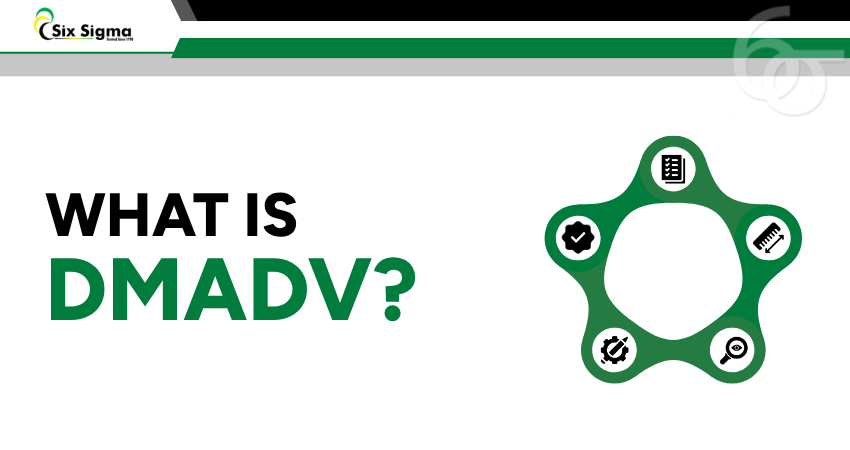
DMADV is a Six Sigma methodology used to design new products, services, or processes with a focus on quality, performance, and customer requirements. DMADV stands for Define, Measure, Analyse, Design, and Verify, and helps organisations identify potential issues early and develop solutions that meet customer expectations.
By following a structured and data-driven approach, DMADV helps businesses reduce risks, improve quality, and enhance overall performance. It is widely used to create new products or processes that require accuracy, consistency, and long-term efficiency.

DMADV is mainly used to develop new products, services, or processes that meet customer requirements and quality standards. It helps organisations create innovative solutions from the ground up while reducing the chances of defects, inefficiencies, and performance issues during the development stage.
Also, DMADV is used to introduce major improvements or features to existing products and services when current processes no longer meet business or customer expectations. By following a structured and data-driven approach, it supports organisations in solving future challenges, improving reliability, and achieving long-term operational success.
The DMADV methodology follows five structured phases that help organisations design high-quality products, services, and processes efficiently. Each phase builds on the previous one, ensuring a logical and systematic approach to design and quality improvement. Let’s explore them below:
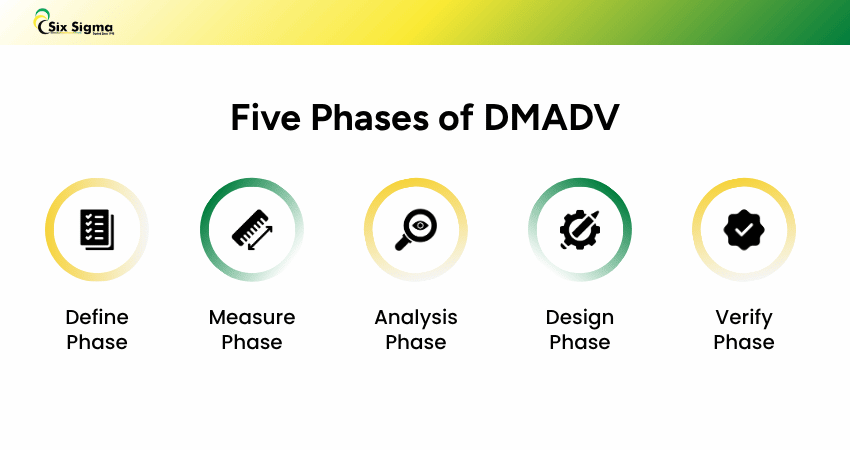
The Define phase focuses on identifying customer requirements, business goals, and project objectives clearly. Teams gather the Voice of the Customer (VOC) through surveys, interviews, and feedback. This helps ensure that the project is aligned with customer expectations and provides a clear direction before the design process begins.
In the Measure phase, teams identify and measure the Critical to Quality (CTQ) factors that directly affect customer satisfaction. Clear metrics and measurement systems are established to evaluate performance and support accurate, data-driven decision-making throughout the project.
The Analyse phase focuses on identifying the underlying or root causes of potential issues that may affect the product, service, or process. Here, teams analyse data, evaluate risks, and explore different design alternatives to find the most effective and reliable solution before development begins.
During the Design phase, teams create and refine the final solution based on insights gathered earlier. Conceptual designs, prototypes, and models are developed and tested. This stage focuses on translating ideas into practical, high-quality designs that meet both customer and business requirements.
The Verify phase ensures that the final product, service, or process performs effectively under real-world conditions. Teams conduct testing, pilot runs, and evaluations. This step confirms that the solution meets quality standards, performs reliably, and delivers the expected value before full implementation.
Strengthen your quality management skills with the Six Sigma Green Belt Training – Join now!
The DMADV methodology follows several important strategies that help organisations design high-quality solutions efficiently. These strategies ensure that outcomes are both customer-focused and performance-driven. Some key strategies include:
a) Focus on Customer Requirements: DMADV prioritises customer needs and expectations to ensure the final product or service delivers maximum value and quality.
b) Data-driven Decision-making: The methodology uses data analysis and measurable performance indicators to support accurate and reliable decision-making throughout the design process.
c) Encourages Innovation: DMADV allows organisations to develop flexible and innovative designs instead of relying on fixed approaches or existing process structures.
d) Improves Efficiency and Quality: By identifying potential issues early, DMADV helps businesses improve operational efficiency, reduce defects, and enhance overall performance.
e) Continuous Evaluation and Verification: The methodology focuses on analysing, testing, and evaluating designs to ensure the final solution consistently meets quality standards and customer expectations.
DMADV offers several benefits for organisations aiming to design high-quality products, services, and processes. However, it also has certain limitations that businesses should consider before implementation. Let’s look at them below:
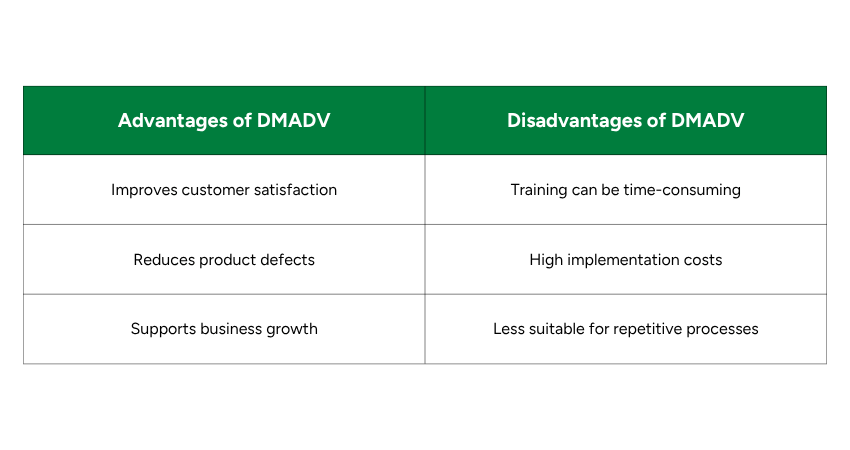
Some key advantages include:
a) Improves Customer Satisfaction: DMADV focuses strongly on customer requirements, helping organisations develop solutions that meet customer expectations effectively.
b) Reduces Product Defects: The methodology helps identify and resolve issues early in the design stage, reducing defects and improving overall quality.
c) Supports Business Growth: By improving product quality and customer satisfaction, DMADV can contribute to increased sales, profitability, and long-term business success.
Some key disadvantages include:
a) Time-consuming Training: Implementing DMADV requires specialised Six Sigma training, which can take significant time and effort.
b) High Implementation Costs: The methodology may involve higher costs due to training, research, analysis, and testing activities.
c) Less Suitable for Repetitive Processes: DMADV is mainly focused on innovation and new design development, making it less effective for repetitive or already stable processes.
Build strong quality management foundations with the Six Sigma Yellow Belt Training – Sign up now!
DMADV is widely used across industries to design high-quality products, services, and processes that meet customer and business requirements effectively. Some common examples of DMADV usage include:
a) Packaging Industry: DMADV is used to design new product packaging or improve existing packaging for better quality, usability, and customer satisfaction.
b) Healthcare Industry: Healthcare organisations use DMADV to develop high-quality medical products and processes where reducing defects is critical for patient safety.
c) Manufacturing Industry: Manufacturers apply DMADV to reduce defects, improve production processes, and enhance product and service quality.
d) Service Industry: Service providers use DMADV to design efficient customer service systems, including staffing plans, response times, and service processes that improve customer experience.
DMADV and DMAIC are both Six Sigma methodologies used to improve quality and business performance. However, they differ in purpose, approach, and application. Understanding these differences helps organisations choose the right method based on their specific needs.
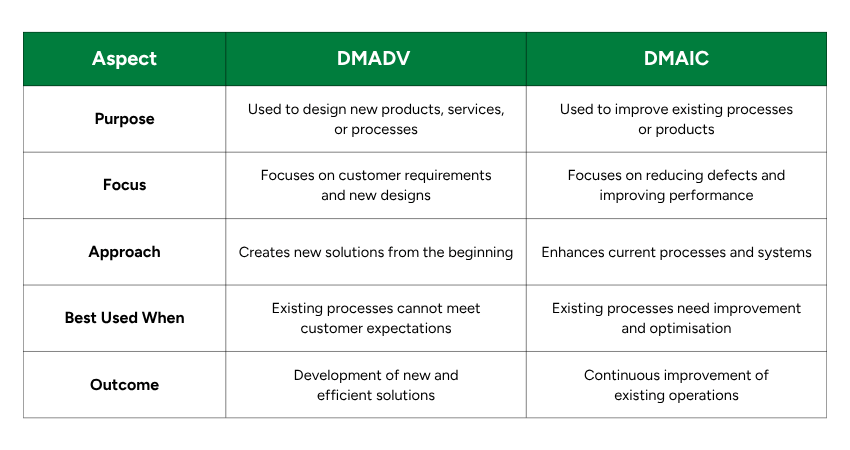
DMADV is mainly used when organisations need to create completely new products, services, or processes that align with customer expectations and business goals. It follows a structured design approach that focuses on innovation, quality, and long-term efficiency.
In contrast, DMAIC is used to improve existing processes by identifying defects, analysing performance issues, and implementing improvements. While DMADV supports new development, DMAIC focuses on continuous improvement and operational optimisation.
A successful DMADV implementation depends on applying the right practices and tools throughout the design process. These practices ensure accuracy, reduce risks, and improve the quality of outcomes. Let’s explore them below:
a) Cross-functional Team Collaboration: A key practice in DMADV is building cross-functional teams with members from engineering, operations, marketing, and customer service. This helps support balanced decision-making and better project outcomes.
b) Data Collection and Statistical Analysis Tools: Tools like surveys, focus groups, process monitoring systems, hypothesis testing, regression analysis, and Design of Experiments (DOE) help teams collect and analyse data for accurate decision-making.
c) Design and Prototyping Tools: Teams use CAD software, 3D modelling tools, prototyping software, and simulation platforms to create, visualise, and test designs before final implementation.
d) Risk Management Practices: Practices like Failure Mode and Effects Analysis (FMEA), risk assessment, and contingency planning help organisations identify and reduce potential risks early in the project.
e) Continuous Testing and Validation: Regular testing, verification, and performance evaluation are important practices that ensure the final solution meets customer requirements and business objectives.
DMADV is useful for designing high-quality products, services, and processes by focusing on customer needs, performance, and efficiency from the very beginning. By following a structured and data-driven approach, businesses can reduce defects, improve innovation, and achieve better operational success in competitive industries.
Learn to improve business quality, operational efficiency, and results faster with the Six Sigma Training – Sign up now!


Thank You For Your Enquiry.
Our representative will get in touch with you shortly. You can also:Call Us: +442036084550
Email Us: [email protected]



 Home
Home