

Call us:
+442036084550
Monday-Sunday (24 Hours)


 2026-05-16
James Smith

Imagine a process where every product, order, invoice, or service request has several chances for errors to occur. Even one small mistake can affect quality, customer satisfaction, and overall performance. This is where DPMO helps organisations measure defects clearly and understand how effectively their processes are performing.
But exactly What is DPMO in Six Sigma? It is a quality metric that measures the number of defects in a process for every one million possible defect opportunities. In this blog, we will discuss what DPMO means in Six Sigma, why it is important, how to calculate it and practical examples. Read ahead to learn more!
DPMO stands for Defects Per Million Opportunities. It is a Six Sigma metric used to measure how many defects occur in a process for every one million possible defect opportunities. In simple words, it shows how likely a process is to produce errors when there are multiple chances for something to go wrong.
A defect is anything that fails to meet customer requirements, process standards, or quality expectations. An opportunity is any point where a defect could occur. For example, in an online order process, possible defect opportunities may include incorrect product selection, wrong delivery address, payment failure, late shipment, and damaged packaging.

DPMO is not just a calculation method; it is a powerful decision-making tool that supports continuous improvement initiatives. It helps organisations shift from intuition-based decisions to data-driven strategies. Below you will find some ways in which DPMO is important in process improvement:
DPMO helps organisations measure how well a process performs by showing the number of defects for every one million opportunities. This makes performance easier to track, compare, and evaluate. It also helps teams understand whether a process is improving, stable, or producing too many errors.
DPMO makes it easier to identify where defects are occurring most often within a process. By analysing defect patterns, teams can find weak points, recurring issues, and areas that need attention. This helps organisations focus improvement efforts on the problems that create the greatest impact.
DPMO supports quality goal setting by giving organisations a clear numerical target to work towards. Teams can use it to define acceptable defect levels, monitor progress, and measure improvement over time. This makes quality goals more specific, realistic, and easier to evaluate.
DPMO helps teams make decisions based on measurable data rather than assumptions or guesswork. It provides clear evidence about defect levels, process capability, and improvement needs. This allows managers to prioritise actions, allocate resources effectively, and choose solutions that are backed by performance data.
Calculating DPMO requires a structured approach to ensure accuracy and consistency. Below, we will break down the steps involved in calculating DPMO:
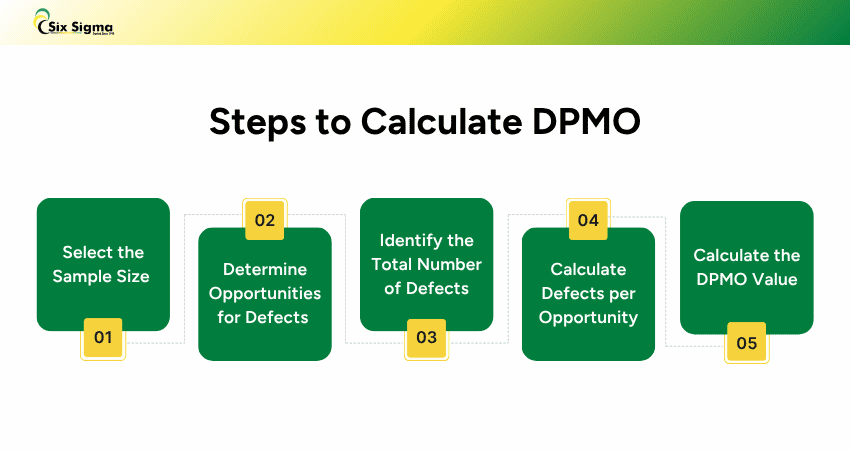
Start by selecting the number of units you want to inspect or measure. A unit can be a product, invoice, transaction, service request, order, or any other process output. The sample size should be large enough to represent the actual process performance.
Next, identify how many possible defect opportunities exist in each unit. A defect opportunity is any point where an error can occur. These opportunities should be clearly defined and linked to customer requirements, quality standards, or process expectations.
Count the total number of defects found within the selected sample. A defect is any error, fault, or failure to meet the required standard. Remember that one unit can have more than one defect, so count each defect separately.
Now, calculate Defects per Opportunity, also known as DPO. This shows the proportion of defects compared with the total number of possible defect opportunities.
Formula:
DPO = Total Defects ÷ Total Defect Opportunities
Total Defect Opportunities = Number of Units × Opportunities per Unit
Finally, multiply the DPO value by 1,000,000 to calculate DPMO. This converts the defect rate into defects per million opportunities.
Formula:
DPMO = DPO × 1,000,000
A lower DPMO indicates stronger process performance, while a higher DPMO shows that the process has more defects and may need improvement.
Advance your career with the
Six Sigma Black Belt Course
and lead continuous improvements. Sign up today!
After exploring what DPMO means in Six Sigma, it is helpful to understand this metric through practical examples. Let’s look at a few examples to see how DPMO is used to measure process performance and quantify defects effectively.
Imagine a company that manufactures electronic devices. The quality team inspects 1,000 devices. Each device has five possible defect opportunities:
1) Screen defect
2) Battery issue
3) Button failure
4) Speaker problem
5) Charging port issue
During inspection, the team finds 120 total defects.
Now Calculate DPMO:
Number of units = 1,000
Opportunities per unit = 5
Total opportunities = 1,000 × 5 = 5,000
Total defects = 120
DPO = 120 ÷ 5,000 = 0.024
DPMO = 0.024 × 1,000,000 = 24,000
The DPMO is 24,000. This means that if the process had one million defect opportunities, it would be expected to produce 24,000 defects.
This result helps the company understand that its production process needs improvement. The team can then analyse which defect type occurs most often and take corrective action.
Now consider a customer support team that reviews 500 support tickets. Each ticket has four possible defect opportunities:
1) ncorrect customer details
2) Delayed response
3) Wrong solution
4) Missing follow-up
During the review, the team finds 40 defects.
Now Calculate DPMO:
Number of units = 500
Opportunities per unit = 4
Total opportunities = 500 × 4 = 2,000
Total defects = 40
DPO = 40 ÷ 2,000 = 0.02
DPMO = 0.02 × 1,000,000 = 20,000
The DPMO is 20,000. This means the support process produces 20,000 defects per million opportunities.
This insight can help the team improve response quality, update support scripts, provide better training, or improve ticket review processes.
Enhance your skills with the
Six Sigma Black Belt Upgrade Course
for deeper analytics and strategic impact. Register now!
DPMO is a useful metric, but it must be calculated carefully. If the data is unclear or inconsistent, the result may not reflect actual process performance. Here are some common mistakes and challenges.
One common mistake is using a sample that does not represent the full process. For example, checking only one factory shift or only simple customer tickets may give a limited view of actual performance.
To avoid this, the sample should reflect normal process conditions, different work types, shifts, or transaction levels. A reliable sample helps produce a more accurate and meaningful DPMO result.
Incorrectly defining defect opportunities can make the DPMO value misleading. If too many opportunities are added, the result may look better than reality. If too few are counted, the process may appear worse than it is.
For example, if an invoice has five real error points, the team should not count 15 opportunities just to reduce the DPMO value. Defect opportunities should be based on actual customer requirements, quality standards, or process expectations.
DPMO shows how many defects are occurring, but it does not explain why they are happening. Variation may come from unclear instructions, machine issues, poor materials, manual errors, system problems, or inconsistent input data.
To find the root cause, DPMO should be used with tools such as Pareto charts, fishbone diagrams, process maps, and the 5 Whys technique. This helps teams identify the real source of defects and choose the right corrective action.
Calculating DPMO accurately requires clear data, consistent measurement, and a proper understanding of defect opportunities. Following the right practices helps organisations avoid misleading results and make better process improvement decisions. Here are some best practices for calculating DPMO:
Before calculating DPMO, clearly define what counts as a defect. A defect should be any failure to meet customer, quality, or process requirements. Clear definitions prevent confusion and ensure everyone measures defects in the same way.
Each unit may have more than one opportunity for a defect. For example, an invoice may have opportunities for errors in the amount, date, customer name, and tax details. Identifying these opportunities correctly is important because incorrect counts can distort the final DPMO value.
The sample size should be large enough to represent the actual process performance. A very small sample may give inaccurate results and may not reflect the real defect rate. Using a reliable sample helps organisations make decisions based on stronger data.
Data should be collected using the same method, time period, and inspection criteria. If teams use different standards, the DPMO result may not be reliable. Consistent data collection ensures fair comparison across departments, time periods, or process stages.
When recording defects, make sure the same defect is not counted multiple times by mistake. Duplicate counting can increase the defect total and make the process appear worse than it really is. Accurate defect counting improves the reliability of the DPMO calculation.
Before applying the DPMO formula, review the collected data for errors, missing values, or inconsistencies. This helps ensure that the number of units, defects, and opportunities is correct. Validated data leads to more accurate and meaningful results.
DPMO becomes more useful when it is tracked regularly. Comparing results over time helps organisations understand whether a process is improving, declining, or remaining stable. This also supports continuous improvement and helps teams measure the impact of corrective actions.
Understanding DPMO in Six Sigma helps organisations turn defect data into clear improvement actions. It supports better process measurement, accurate quality tracking, and smarter decision-making. When calculated correctly, DPMO helps teams reduce errors, improve consistency, and build more reliable processes over time. After all, every reduced defect is one step closer to better quality.
Develop process improvement expertise with Six Sigma Yellow Belt Course for all levels and industries. Sign up now!


Thank You For Your Enquiry.
Our representative will get in touch with you shortly. You can also:Call Us: +442036084550
Email Us: [email protected]



 Home
Home