
Call us:
+442036084550
Monday-Sunday (24 Hours)


 2026-05-16
James Smith
Every project aims to improve quality and efficiency, but organisations often use different approaches to achieve these goals. Some rely on structured, data-driven processes to reduce errors, while others prefer flexible methods that adapt quickly to customer needs. That is why understanding Six Sigma vs Agile helps organisations choose the methodology that best fits their project goals, team dynamics, and business priorities.
As industries continue to evolve, businesses need the right Project Management approaches to drive operational efficiency and improve customer satisfaction. The comparison between Six Sigma vs Agile is important because each methodology provides unique advantages for different project types. Read this blog to understand the differences and which methodology may be best for your projects. Let’s begin!
Six Sigma is a data-driven methodology focused on improving processes by reducing defects, minimising variation, and increasing operational efficiency. Its goal is to improve quality and deliver more consistent business performance.
Developed by Motorola in the 1980s, Six Sigma follows a structured framework called Define, Measure, Analyse, Improve, and Control (DMAIC). This methodology uses data analysis and process measurement to identify issues, improve workflows, and support continuous business improvement across organisations.
Agile is an iterative and collaborative methodology to Project Management that focuses on flexibility, continuous improvement, and faster delivery. It helps teams adapt quickly to changing business and customer needs while improving teamwork and overall project efficiency.
Agile works by dividing projects into smaller stages or iterations, allowing teams to deliver work continuously and gather regular feedback throughout the project lifecycle. This approach encourages adaptability, faster problem-solving, and ongoing improvement, helping organisations deliver value more efficiently.
Both Six Sigma vs Agile aim to improve project outcomes, but they differ significantly in their approach, processes, tools, and project execution style. Let’s look at the differences between Six Sigma and Agile below to help you choose the right methodology:
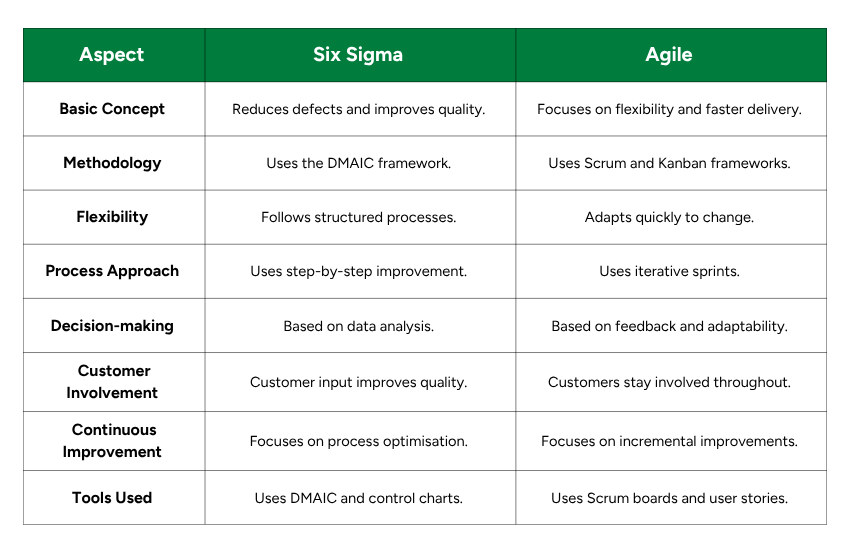
Six Sigma is a data-driven methodology focused on improving processes by reducing defects, minimising variation, and increasing operational efficiency. It uses structured frameworks like DMAIC and relies heavily on data analysis and process measurement to improve quality and consistency.
In contrast, Agile is an iterative and collaborative approach to Project Management that focuses on flexibility, adaptability, and continuous improvement. Agile teams work in short iterations called sprints, enabling them to deliver work continuously, gather regular feedback, and respond quickly to changing customer and business requirements.
Six Sigma follows a structured methodology that uses statistical analysis, process mapping, and root cause analysis to identify and eliminate defects. The DMAIC framework guides teams through a step-by-step improvement process focused on long-term process stability and quality enhancement.
In contrast, Agile uses adaptive methodologies, such as Scrum and Kanban, to support iterative development and continuous collaboration. It emphasises rapid feedback, incremental delivery, and continuous adaptation to changing project requirements.
Six Sigma follows a more controlled and structured approach, where changes are implemented carefully to maintain process consistency and minimise variation. This makes it highly suitable for environments that prioritise standardisation and quality assurance.
In contrast, Agile emphasises flexibility and adaptability by encouraging teams to respond quickly to changing customer needs and project requirements. Its iterative approach allows continuous adjustments, making it ideal for fast-changing and dynamic project environments.
Six Sigma follows the DMAIC process, which includes Define, Measure, Analyse, Improve, and Control. This structured process helps organisations identify problems, analyse root causes, implement improvements, and maintain long-term process performance.
In contrast, Agile follows an iterative and incremental process where projects are divided into sprints. Agile teams use practices like sprint planning, daily stand-ups, reviews, and retrospectives to deliver continuous improvements and gather regular customer feedback.
In Six Sigma, customer involvement mainly focuses on gathering customer requirements and feedback to improve process quality and align improvements with customer expectations. Customer data is primarily used to identify areas for process improvement and quality enhancement.
In contrast, Agile supports continuous customer involvement throughout the project lifecycle. Here, customers or product owners actively participate in sprint planning, reviews, and feedback sessions, helping teams adapt quickly and deliver solutions that meet customer needs.
Build a strong foundation in process improvement with the Six Sigma Yellow Belt Training – Join now!
Six Sigma relies on data-driven decision-making using statistical analysis and measurable evidence to identify problems and improve processes. This approach supports accurate and structured decision-making but may require more time for analysis.
In contrast, Agile uses adaptive decision-making that focuses on flexibility and rapid responses to change. Decisions are generally based on the most recent feedback and project requirements, allowing teams to make quick adjustments during development.
Six Sigma uses tools such as DMAIC, process mapping, control charts, Fishbone diagrams, and root cause analysis to identify process issues and improve operational performance. These tools and techniques support structured problem-solving and process optimisation.
In contrast, Agile uses user stories, Scrum boards, Kanban boards, sprint planning, burndown charts, and daily stand-ups to manage iterative development and improve collaboration. Some popular Agile tools include Jira, Trello, and Asana for project tracking and workflow management.
Six Sigma focuses on continuous improvement through the DMAIC cycle, which helps organisations identify root causes, implement data-driven solutions, and maintain long-term process improvements. Here, improvements are generally planned and process focused.
In contrast, Agile promotes continuous improvement through regular retrospectives and iterative development. Here, teams frequently review their performance, gather feedback, and make small improvements during each sprint to enhance productivity and collaboration.
Six Sigma follows a structured timeline where significant time and resources are invested in data collection, analysis, and process improvement planning. This approach supports detailed process optimisation and long-term quality improvement.
In contrast, Agile uses shorter development cycles, allowing teams to manage time and resources more flexibly. Also, resource allocation can be adjusted quickly based on changing priorities, helping organisations deliver results faster and respond efficiently to project changes.
Six Sigma measures success using data-driven metrics like defect rates, process capability, and process performance. Its primary focus is on improving quality, reducing errors, and maintaining consistent operational outcomes.
In contrast, Agile measures success through team productivity, customer satisfaction, delivery speed, and continuous feedback. Tools such as velocity tracking and burndown charts help Agile teams monitor progress and improve performance during each sprint.
Learn to solve business problems confidently by signing up for the Six Sigma Green Belt Training today!
Before choosing between Agile and Six Sigma, organisations should evaluate their project goals, customer expectations, working style, and business priorities. Let’s look at some of the key factors below that one must consider before selecting the methodology:
1) Project Scope: Six Sigma is ideal for improving processes, reducing defects, and maintaining quality standards. On the other hand, Agile is suitable for projects that require flexibility, continuous delivery, and quick adaptation to change.
2) Customer Requirements: Six Sigma prioritises meeting quality expectations through process improvement and consistency. On the other hand, Agile focuses heavily on continuous customer feedback and faster value delivery.
3) Team and Organisational Culture: Six Sigma is ideal for organisations that prefer structured, data-driven decision-making. On the other hand, Agile works best in collaborative and fast-changing environments.
4) Project Complexity and Uncertainty: Six Sigma is effective for stable processes that require controlled and measurable improvements, while Agile performs well in dynamic projects with evolving requirements.
5) Project Timeline: Usually, Six Sigma projects involve detailed analysis and may require more time for long-term process improvement. On the other hand, Agile delivers work in shorter cycles, allowing quicker feedback and faster results.
Although Six Sigma and Agile are different from one another, they share common goals related to improving project outcomes, customer satisfaction, and business performance. Let’s look at them below:
1) Customer Focus: Both Six Sigma and Agile prioritise customer needs and aim to deliver high-quality products or services that meet customer expectations.
2) Data-driven Decision-making: Both methodologies use data, feedback, and performance measurements to support informed decision-making and improve project outcomes.
3) Continuous Improvement: Six Sigma and Agile encourage ongoing improvement by regularly reviewing processes, identifying issues, and implementing necessary changes.
4) Collaboration and Teamwork: Both methodologies promote teamwork, communication, and collaboration between cross-functional teams to achieve project goals effectively.
5) Incremental Approach: Both Six Sigma and Agile support gradual improvements by breaking work into manageable stages, allowing teams to learn, adapt, and improve continuously.
Choosing the right Project Management methodology can improve project efficiency, quality, and customer satisfaction. While Six Sigma focuses on process improvement and consistency, Agile emphasises flexibility, faster delivery, and continuous improvement for evolving project needs. Understanding Six Sigma vs Agile helps organisations select the methodology that suits their project goals and business priorities.
Learn smarter process improvement strategies and drive operational excellence with the Six Sigma Training Courses - Join today!


The four principles of Agile include:
1) Individuals and interactions over processes and tools
2) Working software over comprehensive documentation
3) Customer collaboration over contract negotiation
4) Responding to change by following a plan


Thank You For Your Enquiry.
Our representative will get in touch with you shortly. You can also:Call Us: +442036084550
Email Us: [email protected]



 Home
Home