
Call us:
+442036084550
Monday-Sunday (24 Hours)


 2026-04-13
James Smith
Every organisation aims to deliver faster results, reduce errors, and improve efficiency, yet daily processes become complex and inefficient over time. This is where Lean Six Sigma Tools make a real impact. They help identify gaps, eliminate waste, and streamline workflows, enabling teams to work more effectively and deliver better outcomes.
In today’s business environment, relying on guesswork is no longer enough. By using the right Lean Six Sigma Tools, organisations can make data-driven decisions, improve consistency, and respond better to customer needs. In this blog, you will explore what Lean Six Sigma is, its top tools, and more. Let’s begin!
Lean Six Sigma is a structured process improvement approach that combines Lean and Six Sigma to enhance efficiency, quality, and performance. Lean focuses on improving process flow and enabling continuous improvement, while Six Sigma uses data-driven methods to reduce variation and defects. Together, they enable organisations to streamline operations and deliver consistent outcomes that meet customer expectations.
It matters because Lean Six Sigma supports informed decision-making, optimises processes, and drives sustainable improvement. By combining continuous improvement with analytical techniques, it enhances quality, minimises costs, and boosts customer satisfaction across industries such as healthcare, IT, and retail.
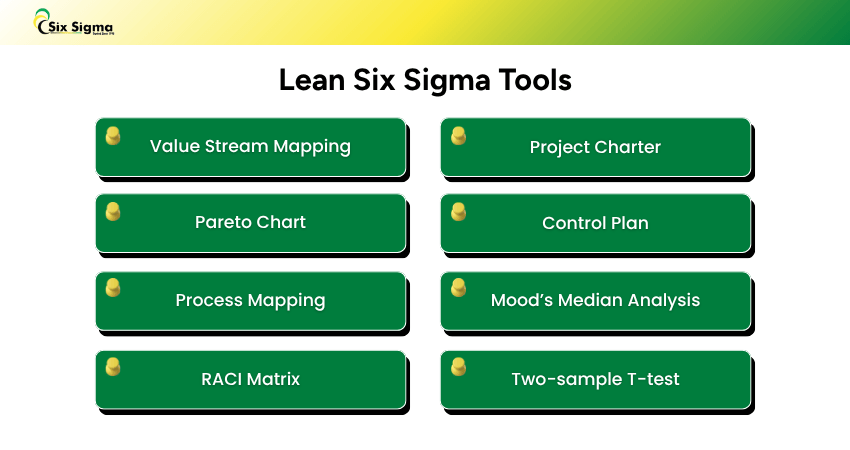
Lean Six Sigma Tools improve processes by reducing waste and increasing efficiency. They provide structured methods to analyse workflows, identify problems, and implement effective solutions. Let’s look at some of the best Lean Six Sigma Tools below:
Value Stream Mapping (VSM) is used to create a detailed visual representation of a process from start to finish. It helps teams identify bottlenecks, inefficiencies, and delays. By comparing the current state with a future state map, organisations can improve flow and reduce waste.
Key Benefits of Using This Tool:
a) Provides a complete view of the process
b) Identifies bottlenecks and inefficiencies
c) Highlights opportunities for improvement
d) Supports better workflow design
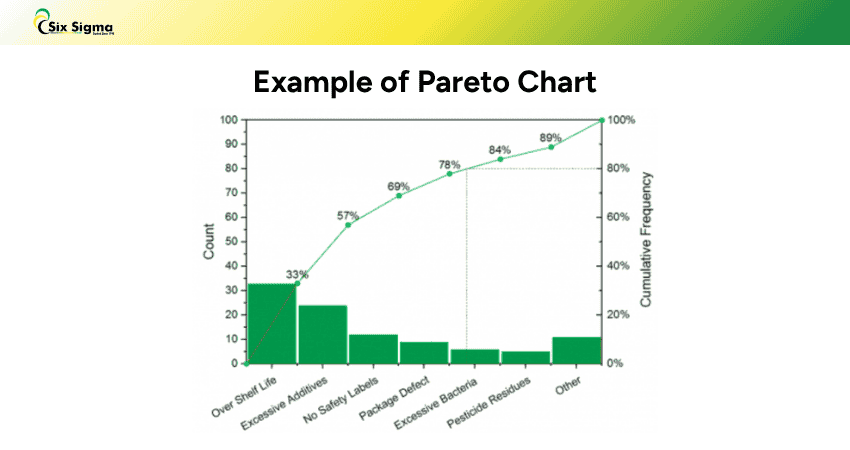
A Pareto Chart is a statistical tool used for identifying the most significant factors contributing to a problem. Based on the 80/20 principle, it shows that a small number of causes lead to most of the issues. This helps teams focus on high-impact areas first.
Key Benefits of Using This Tool:
a) Prioritises key issues effectively
b) Displays data in an easy-to-understand format
c) Helps allocate resources efficiently
d) Supports data-driven decision-making
Process Mapping involves visually outlining each step of a process to understand how work is completed. It helps identify delays, inefficiencies, and unnecessary steps, making it easier to improve performance and train team members.
Key Benefits of Using This Tool:
a) Clearly shows each process step
b) Helps identify inefficiencies
c) Supports training and knowledge sharing
d) Enables removal of non-value-added steps
The RACI Matrix is used for defining roles and responsibilities in a project or process by identifying who is Responsible, Accountable, Consulted, and Informed (RACI). It helps avoid confusion, ensures accountability, and improves coordination across teams.
Key Benefits of Using This Tool:
a) Clarifies roles and responsibilities
b) Improves team communication
c) Prevents overlap and gaps in tasks
d) Supports better accountability
A Project Charter defines the purpose, scope, objectives, and stakeholders of a project. It acts as a guiding framework, ensuring everyone understands the goals and direction from start to finish.
Key Benefits of Using This Tool:
a) Defines clear project goals and scope
b) Aligns stakeholders and expectations
c) Establishes roles and responsibilities
d) Provides a strong project foundation
Strengthen your analysis skills and drive improvements with Lean Six Sigma Green Belt Training now!
A Control Plan ensures that processes remain stable and deliver consistent quality after improvements are implemented. It outlines the checks, tools, and actions required to maintain standards over time.
Key Benefits of Using This Tool:
a) Maintains quality after improvements
b) Lists monitoring tools and responsibilities
c) Prevents recurring issues
d) Supports long-term process stability
Mood’s Median Analysis is used to determine the median of a dataset, especially when the data contains outliers or extreme values. It provides a more reliable measure of central tendency, ensuring results are not heavily influenced by unusual data points.
Key Benefits of Using This Tool:
a) Works well with data containing outliers
b) Provides a stable measure of central tendency
c) Improves accuracy in data analysis
d) Supports reliable decision-making
The Two-sample T-test is a statistical tool used to compare two sets of data to determine if there is a significant difference between them. It is used to evaluate process improvements, such as comparing results before and after a change.
Key Benefits of Using This Tool:
a) Compares two datasets effectively
b) Validates process improvement results
c) Reduces guesswork with statistical evidence
d) Supports fact-based decisions
An IMR Control Chart tracks individual data points and their variation over time to monitor process performance. It helps identify trends, detect shifts, and ensure processes remain within control limits.
Key Benefits of Using This Tool:
a) Monitors process performance over time
b) Spot variations and deviations early
c) Works well with small data samples
d) Provides clear visual insights
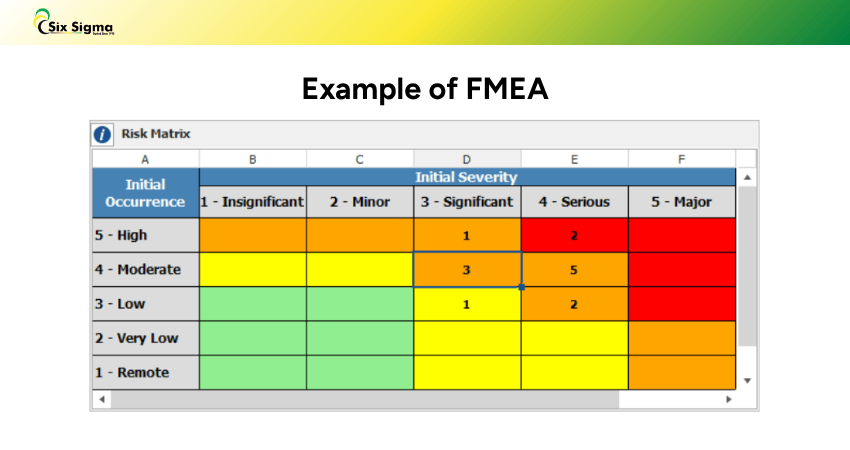
FMEA is used to identify potential failures in a process and assess their impact. It helps teams prioritise risks based on severity and likelihood. This allows them to take preventive actions before issues occur.
Key Benefits of Using This Tool:
a) Identifies potential risks early
b) Prioritises issues based on impact
c) Supports preventive action planning
d) Improves process reliability and safety
Regression Analysis is used to examine the relationship between one or more independent variables and a dependent variable. It helps organisations identify patterns, predict outcomes, and understand how changes in one factor affect another.
Key Benefits of Using This Tool:
a) Identifies relationships between variables
b) Helps predict future outcomes
c) Supports data-driven decision-making
d) Useful across multiple industries and applications
Build a solid foundation in process improvement by joining the Lean Six Sigma Yellow Belt Training today!
Lean Six Sigma techniques help organisations analyse problems, optimise workflows, and deliver reliable outcomes that meet customer expectations. Let's look at them below:
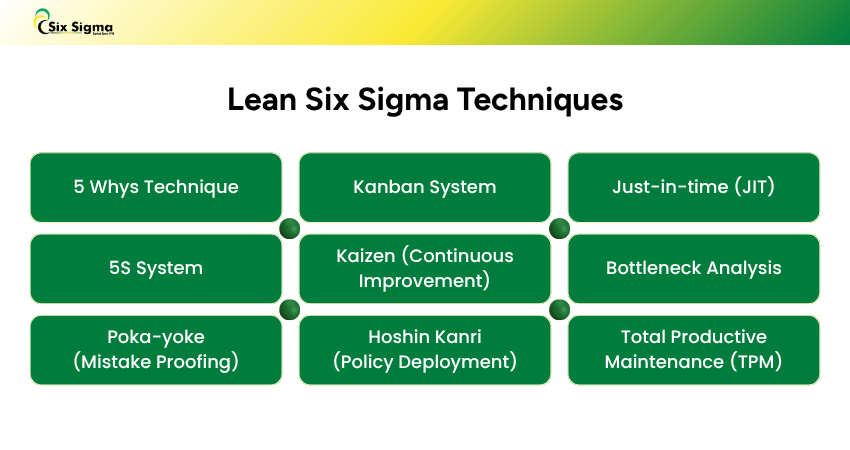
The 5 Whys Technique is a simple and powerful method used to identify the root cause of a problem by repeatedly asking “why.” It helps teams analyse issues more deeply and uncover the underlying cause, making solutions more effective and long-lasting.
Key Benefits of Using This Technique:
a) Identifies the true cause of problems
b) Prevents recurring issues
c) Encourages critical thinking and problem-solving
d) Easy to apply across different processes
Kanban is a visual system used to manage tasks and workflows. It uses boards and cards to show work status, such as tasks to do, in progress, and completed. This improves transparency and ensures a smooth workflow without overload.
Key Benefits of Using This Technique:
a) Visualises tasks for better tracking
b) Reduces delays and work overload
c) Promotes continuous workflow
d) Suitable for teams of all sizes
Just-in-time (JIT) is a Lean approach that produces goods based on customer demand. It focuses on delivering the right items at the right time, reducing excess inventory and improving efficiency.
Key Benefits of Using This Technique:
a) Reduces inventory levels and storage costs
b) Improves cash flow and space utilisation
c) Minimises waste from overproduction
d) Enhances process efficiency and responsiveness
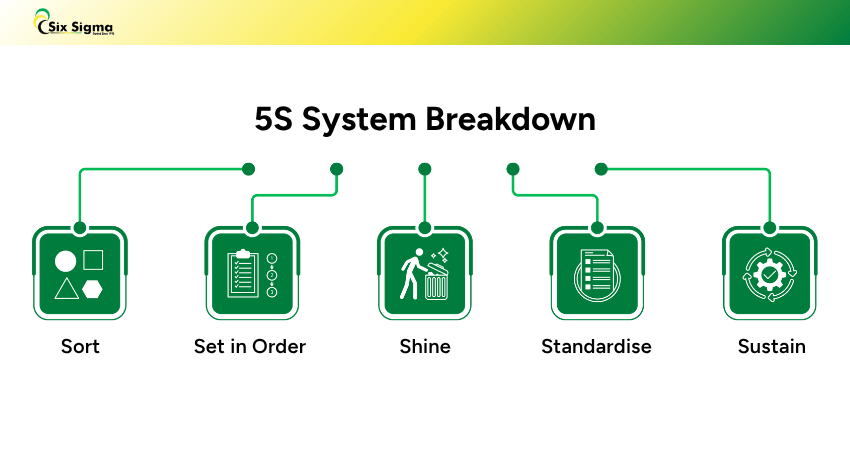
The 5S System is a workplace organisation method that ensures a clean, efficient, and safe environment. It includes five steps: Sort, Set in order, Shine, Standardise, and Sustain. This structured approach helps teams maintain order and reduce time wasted searching for tools.
Key Benefits of Using This Technique:
a) Keeps the workplace organised and clutter-free
b) Saves time by improving accessibility
c) Enhances safety and reduces risks
d) Builds discipline and consistency in processes
Kaizen focuses on making small, continuous improvements in processes rather than large, disruptive changes. It encourages employees to contribute ideas and improve their tasks, fostering a culture of continuous improvement and teamwork.
Key Benefits of Using This Technique:
a) Encourages regular, incremental improvements
b) Reduces waste and improves quality
c) Promotes teamwork and employee involvement
d) Makes change easier and more sustainable
Move from practitioner to process leader by joining the Lean Six Sigma Black Belt Upgrade Training now!
Bottleneck Analysis identifies the stage in a process that limits overall performance or throughput. By focusing on the weakest point, organisations can improve their entire process and increase overall efficiency.
Key Benefits of Using This Technique:
a) Identifies process constraints clearly
b) Improves overall throughput and efficiency
c) Helps prioritise improvement efforts
d) Reduces delays and workflow disruptions
Poka-yoke is a technique used to prevent or detect errors during a process. It involves designing systems or tools that make mistakes difficult or impossible. This ensures defects are caught early or avoided altogether.
Key Benefits of Using This Technique:
a) Prevents errors before they occur
b) Improves product and process quality
c) Reduces rework and defects
d) Enhances reliability and consistency
Hoshin Kanri is a strategic planning technique that aligns organisational goals with daily activities. It connects top-level strategy with middle management plans and frontline execution. This ensures everyone works towards shared objectives.
Key Benefits of Using This Technique:
a) Aligns strategy with daily operations
b) Improves communication across all levels
c) Ensures consistent progress towards goals
d) Reduces waste caused by misalignment
Total Productive Maintenance (TPM) is a proactive maintenance technique focused on maximising equipment performance. It encourages operators to take responsibility for routine maintenance, creating a shared ownership model between production and maintenance teams.
Key Benefits of Using This Technique:
a) Increases equipment uptime and reliability
b) Reduces breakdowns and defects
c) Improves productivity and process efficiency
d) Encourages team involvement and ownership
Applying the right Lean Six Sigma Tools and techniques helps organisations improve processes, reduce waste, and achieve consistent results. By applying them effectively, teams can enhance efficiency, make better decisions, and drive continuous improvement while meeting evolving customer expectations.
Build efficiency skills and improve organisational workflows with Lean Six Sigma Training – Join now!


Thank You For Your Enquiry.
Our representative will get in touch with you shortly. You can also:Call Us: +442036084550
Email Us: [email protected]



 Home
Home