
Call us:
+442036084550
Monday-Sunday (24 Hours)


 2026-07-11
James Smith
Ever found yourself wondering why some teams finish projects faster, make fewer mistakes, and still keep customers happy? It is rarely down to luck. Behind their success is a structured approach that helps them work smarter, eliminate waste, and continuously improve. That's exactly what Lean Six Sigma Principles are designed to achieve.
Whether you're a Project Manager, Business Analyst, Team Leader, or simply looking to improve the way work gets done, these principles can transform everyday processes. In this blog, you'll explore the Lean Six Sigma Principles, why they matter, and how they help organisations improve quality, boost efficiency, and deliver greater customer value. Let's dive in!
Lean Six Sigma is a business improvement methodology that combines Lean and Six Sigma to help organisations improve quality, increase efficiency, and reduce costs. Lean focuses on removing waste and creating smoother workflows, while Six Sigma uses data-driven methods to reduce process variation and prevent defects. Together, they help businesses deliver greater value to customers and achieve operational excellence.
Rather than addressing problems individually, Lean Six Sigma identifies their root causes and implements lasting improvements. By using frameworks such as Define, Measure, Analyse, Improve, and Control (DMAIC), organisations can streamline processes, boost productivity, enhance customer satisfaction, and build a culture of continuous improvement.

Lean Six Sigma Principles focus on reducing waste, eliminating defects, improving quality, and enhancing efficiency through continuous process improvement. These principles of Lean Six Sigma help organisations streamline workflows, deliver greater customer value, and build more efficient, customer-focused operations:
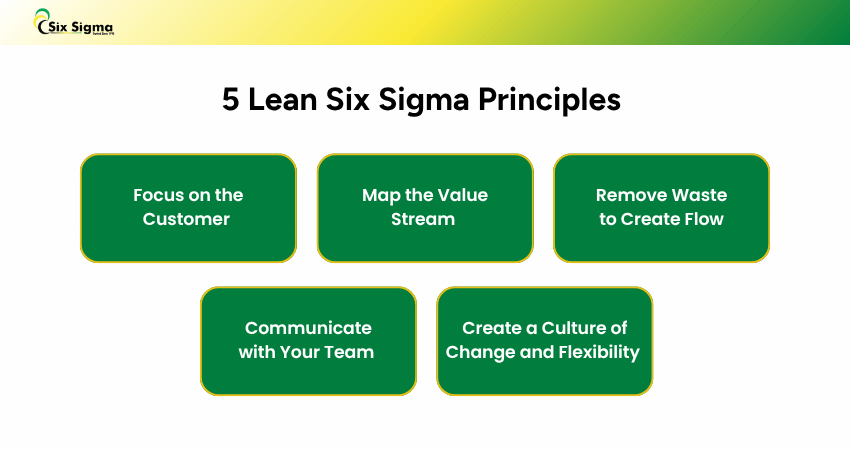
Every Lean Six Sigma initiative begins with the customer. The Lean Six Sigma Principles encourage organisations to understand what customers value most before improving products, services, and processes. Businesses should gather customer feedback, analyse requirements, and identify improvement opportunities that create the greatest value.
By putting customer needs first, organisations can make informed decisions that improve quality, reduce complaints, and enhance the overall customer experience. This customer-focused approach also strengthens loyalty, builds trust, and supports long-term business success.
A value stream covers every step involved in delivering a product or service, from the customer's request to the final delivery. Mapping the value stream helps organisations visualise the entire process, identify delays, bottlenecks, and activities that do not add value, and uncover opportunities for meaningful process improvement.
Once inefficiencies are identified, teams can simplify workflows, eliminate unnecessary steps, and improve collaboration between departments. This creates a smoother process, reduces delays, improves efficiency, and enhances operational performance and customer satisfaction.
After mapping the value stream, organisations apply Lean Six Sigma Principles to eliminate activities that do not contribute to customer value. These may include unnecessary waiting, excess inventory, duplicate work, overproduction, or unnecessary movement, all of which increase costs without improving outcomes.
Removing waste creates a smoother flow of work and allows processes to operate more efficiently. As a result, organisations can reduce costs, shorten delivery times, improve productivity, maintain consistent quality, and make better use of available resources across their operations.
Learn Lean Six Sigma fundamentals and confidently contribute to improvement projects with the Lean Six Sigma Yellow Belt Training – Register now!
Successful Lean Six Sigma implementation depends on strong communication and teamwork. Employees at every level should clearly understand improvement goals, openly share ideas, collaborate to identify challenges and contribute to developing effective solutions.
Open communication encourages knowledge sharing, increases employee engagement, and helps resolve issues before they become bigger challenges. By working collaboratively, teams can implement improvements more effectively and sustain positive results over time.
Lean Six Sigma is an ongoing commitment to continuous improvement, not a one-time initiative. Organisations should encourage employees to embrace change, adapt to new challenges, and regularly look for opportunities to improve processes, performance, and overall business efficiency.
Creating a culture of change and flexibility helps teams adapt to customer needs while responding effectively to changing business demands. This mindset supports innovation, strengthens resilience, encourages continuous learning, and helps organisations achieve long-term operational excellence.
Every improvement journey begins with a single step. By applying Lean Six Sigma Principles, organisations can eliminate inefficiencies, improve quality, and deliver greater value to customers. More than just a methodology, it is a mindset that empowers teams to drive continuous improvement and achieve lasting business success. The journey towards operational excellence begins with consistently applying these principles of Lean Six Sigma every day.
Start your Lean Six Sigma journey and become a confident process improvement professional with the Lean Six Sigma Training – Join now!


The Four Pillars of Lean, derived from the Toyota Way, are:
a) Philosophy: Focus on creating long-term value instead of short-term gains.
b) Processes: Improve workflows by reducing waste and increasing efficiency.
c) People and Partners: Develop employees and build strong relationships with partners.
d) Problem Solving: Identify root causes and continuously improve processes.


Thank You For Your Enquiry.
Our representative will get in touch with you shortly. You can also:Call Us: +442036084550
Email Us: info@sixsigma.co.uk



 Home
Home