
Call us:
+442036084550
Monday-Sunday (24 Hours)


 2026-07-06
James Smith
Every organisation wants to improve efficiency, reduce waste, and deliver better results, but choosing the right improvement methodology can be challenging. Understanding Kaizen vs Six Sigma is the first step towards making informed decisions. While both methodologies aim to improve quality and operational performance, they differ in their approach, implementation, and long-term objectives.
In this blog, we will explore Kaizen vs Six Sigma, covering their definitions, principles, techniques, benefits, real-world examples, and key differences. By the end, you'll have a clear understanding of which methodology best suits your organisation's improvement goals. So, let’s dive in!
Kaizen is a Japanese philosophy that means "change for the better" or "continuous improvement." It focuses on making small, regular improvements to processes, workplace practices, and daily operations. By encouraging employees at all levels to contribute ideas, Kaizen helps improve efficiency, quality, and overall performance over time.
Originally developed in Japan and popularised by companies such as Toyota, Kaizen aims to eliminate waste, improve productivity, and create a culture of ongoing improvement. Through continuously refining processes and encouraging employee involvement, organisations can achieve sustainable growth and long-term operational excellence.
Kaizen is guided by core principles that promote continuous improvement, employee involvement, and waste reduction. These principles include the following:
1) Challenge Assumptions: Question existing processes and remain open to better ways of working.
2) Solve Problems Proactively: Identify issues early and treat them as opportunities for improvement.
3) Promote Accountability: Encourage employees to take ownership and focus on practical solutions.
4) Make Continuous Improvements: Implement small, consistent changes that deliver long-term benefits.
5) Eliminate Root Causes: Address the underlying causes of problems to prevent them from recurring.
6) Empower Employees: Encourage everyone to share ideas and participate in improvement initiatives.
7) Make Decisions Based on Facts: Use observations and measurable data to guide problem-solving and process refinement.
8) Standardise Successful Improvements:
Document and maintain successful changes to ensure improvements are sustained and become part of everyday practice.
Kaizen uses practical techniques to identify inefficiencies and support continuous improvement across an organisation. Some of the most widely used techniques include:
1) Jishuken: Jishuken encourages managers and teams to analyse and evaluate their own processes to identify improvement opportunities.
2) Gemba Walk: A Gemba Walk involves visiting the workplace where tasks are performed to observe processes, engage with employees, and solve problems.
3) Value Stream Mapping (VSM): This technique maps the flow of materials and information to identify waste, bottlenecks, and opportunities for process improvement.
4) PDCA Cycle:
The Plan-Do-Check-Act (PDCA) Cycle provides a structured approach for planning, implementing, evaluating, and standardising improvements.
Many leading organisations have adopted Kaizen to improve efficiency and quality. The examples below demonstrate how this philosophy delivers measurable results in practice:
1) Toyota: Toyota encourages employees to suggest improvements that reduce waste, enhance quality, and increase efficiency. This culture of continuous improvement has contributed to its long-term success.
2) Nestlé: Nestlé uses Value Stream Mapping to reduce waste, improve production efficiency, and maintain consistent product quality through continuous process improvements.
3) Ford Motor Company:
Ford has applied Kaizen principles within the Ford Production System to reduce assembly line waste, shorten changeover times, and improve workstation layouts.
Six Sigma is a data-driven methodology that focuses on improving process quality by reducing defects, errors, and variation. Developed by Motorola in the 1980s, it uses statistical analysis and structured problem-solving techniques to identify and eliminate the root causes of issues.
The methodology aims to improve efficiency, consistency, and customer satisfaction by creating more reliable processes. By reducing waste and minimising process variation, Six Sigma helps organisations achieve better performance while lowering costs. Its structured approach supports informed decision-making based on reliable data and analysis.
Six Sigma is guided by core principles that focus on improving quality, reducing defects, and delivering consistent results. These principles are listed below:
1) Focus on the Customer: Six Sigma begins by understanding customer needs and defining quality based on what customers value. Every improvement aims to enhance customer satisfaction.
2) Understand the Processes: Analyse each stage of a process to identify inefficiencies, reduce variation, and improve overall performance.
3) Reduce Variation and Eliminate Defects: Six Sigma identifies and removes the root causes of process variation and defects to deliver consistent, high-quality outcomes.
4) Make Data-driven Decisions: Decisions are based on measurable data, performance metrics, and statistical analysis rather than assumptions or guesswork.
5) Control and Sustain Improvements:
Monitor processes continuously to ensure improvements are maintained and long-term results are achieved.
Six Sigma uses structured techniques to identify defects, analyse processes, and improve quality. The following techniques are widely used to achieve consistent and measurable process improvements:
1) DMAIC: DMAIC (Define, Measure, Analyse, Improve, Control) is the core Six Sigma framework used to improve existing processes and solve business problems.
2) DMADV: DMADV (Define, Measure, Analyse, Design, Verify) is used to design new processes or products that meet customer requirements and achieve Six Sigma quality standards from the outset.
3) Statistical Process Control (SPC): SPC uses statistical methods to monitor process performance and identify variations before they lead to defects.
4) Failure Mode and Effects Analysis (FMEA): FMEA identifies potential process failures, assesses their impact, and helps organisations take preventive action.
5) Pareto Analysis:
Based on the 80/20 principle, Pareto Analysis helps identify the few causes responsible for most process issues, allowing teams to prioritise improvements.
Many leading organisations use Six Sigma to improve quality, reduce defects, and increase operational efficiency. The following examples show how Six Sigma has been successfully applied across different industries:
1) Motorola: Motorola developed Six Sigma to reduce manufacturing defects and improve product quality. Its success established Six Sigma as a globally recognised process improvement methodology.
2) General Electric: General Electric adopted Six Sigma to increase operational efficiency, reduce costs, and enhance the quality of its products and services across multiple business units.
3) Amazon:
Amazon applies Six Sigma principles within its fulfilment centres and logistics operations to reduce process errors, improve order accuracy, and streamline delivery performance through data-driven process improvements.
Elevate your process improvement and problem-solving skills with
Six Sigma Training
– Sign up soon!
Understanding Kaizen vs Six Sigma helps organisations choose the right improvement methodology for their goals. While Kaizen focuses on continuous, small-scale improvements, Six Sigma uses a structured, data-driven approach to reduce defects and improve process quality. The following are the key differences between Kaizen and Six Sigma:
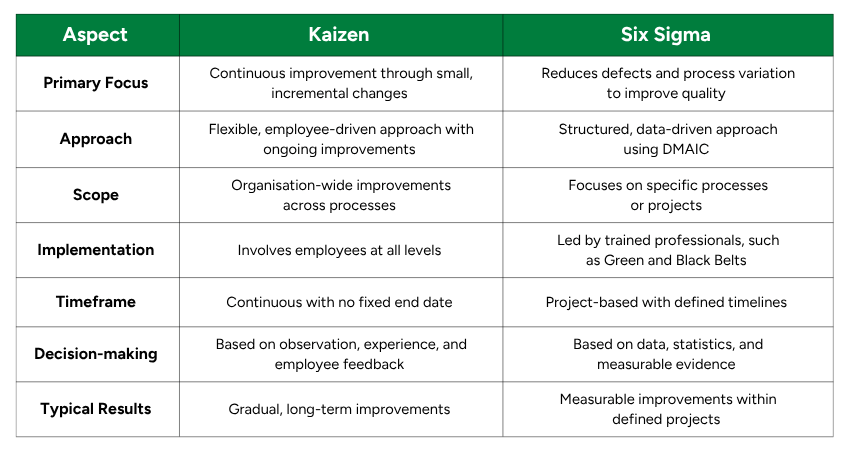
Kaizen focuses on continuous improvement through small, incremental changes that enhance efficiency, eliminate waste, and encourage employee involvement. It promotes a culture where everyone contributes to improving daily operations.
In contrast, Six Sigma focuses on reducing process variation and defects to achieve consistent, high-quality outcomes. It uses statistical analysis and data-driven decision-making to identify and eliminate the root causes of defects.
Kaizen follows a flexible, people-centred approach that encourages employees to identify problems and implement small improvements as part of their daily work. It promotes continuous progress through collaboration and employee empowerment.
However, Six Sigma uses the DMAIC framework to identify issues and drive measurable process improvements. It uses statistical tools and project-based initiatives to solve specific business problems and deliver sustainable process improvements.
Kaizen takes a broad, organisation-wide approach by encouraging continuous improvement across all processes and departments. Even small improvements collectively contribute to long-term organisational growth.
On the other hand, Six Sigma focuses on specific processes or business areas that require measurable improvement. Projects have clearly defined objectives and target key performance metrics such as defect reduction, cycle time, and customer satisfaction.
Kaizen is implemented through active participation from employees at every level. Improvements are introduced continuously through small, practical changes that become part of everyday work.
In contrast, Six Sigma is typically implemented by trained professionals, such as Green Belts and Black Belts, who lead structured improvement projects. These projects involve detailed data analysis, dedicated resources, and defined project timelines.
Kaizen is an ongoing philosophy with no fixed end date. Organisations continuously make small improvements that become part of their daily operations, delivering gradual and sustainable results.
Meanwhile, Six Sigma projects operate within defined timelines and usually require more time due to extensive data analysis and structured problem-solving. The focus is on achieving significant, measurable improvements within a specific project period.
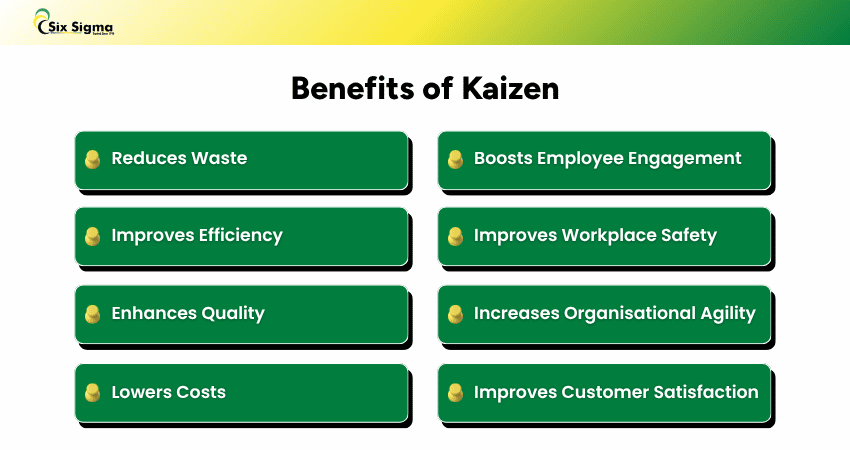
Kaizen delivers long-term improvements through small, continuous changes. Its key benefits include the following:
1) Reduces Waste:
Kaizen eliminates unnecessary activities, excess inventory, waiting time, and other forms of waste to streamline operations.
2) Improves Efficiency:
Simplifying processes helps increase productivity, optimise workflows, and make better use of available resources.
3) Enhances Quality:
Continuous process improvements reduce defects, minimise rework, and ensure consistent product and service quality.
4) Lowers Costs:
By improving workflows and reducing waste, Kaizen helps organisations decrease operational costs without major investments.
5) Boosts Employee Engagement:
Kaizen encourages employees to share ideas and participate in improvement initiatives, increasing motivation and job satisfaction.
6) Improves Workplace Safety:
Standardised processes and organised workspaces help reduce risks and create a safer working environment.
7) Increases Organisational Agility:
Continuous improvement helps organisations adapt quickly to changing customer needs, market demands, and business challenges.
8) Improves Customer Satisfaction:
Efficient processes and consistent quality help organisations deliver better products and services, increasing customer satisfaction and loyalty.
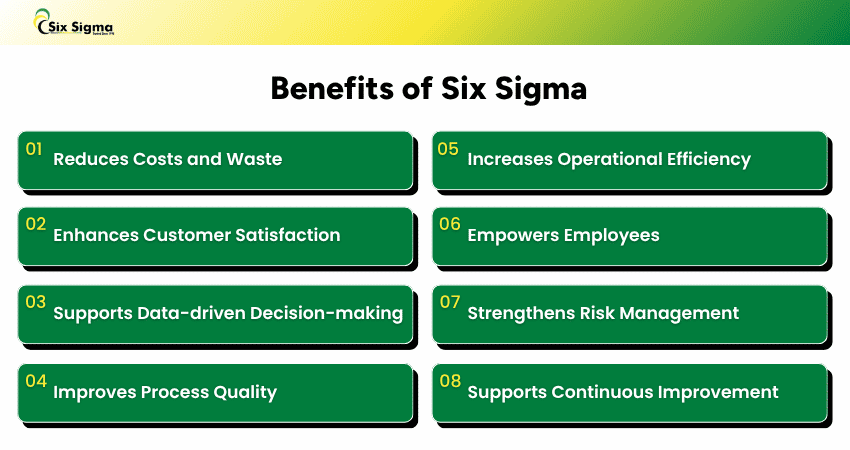
Six Sigma helps organisations improve quality by reducing defects and process variation through a structured, data-driven approach. Its key benefits are listed below:
1) Reduces Costs and Waste:
By eliminating defects and process inefficiencies, Six Sigma helps reduce waste, rework, and operational costs.
2) Enhances Customer Satisfaction:
Delivering consistent, high-quality products and services increases customer confidence, loyalty, and satisfaction.
3) Supports Data-driven Decision-making:
Six Sigma relies on statistical analysis and measurable data, enabling organisations to make informed and accurate decisions.
4) Improves Process Quality:
Reducing process variation helps deliver more reliable, consistent, and predictable outcomes.
5) Increases Operational Efficiency:
Streamlined processes improve productivity, optimise resource utilisation, and eliminate unnecessary activities.
6) Empowers Employees:
Six Sigma develops employees' problem-solving and analytical skills, encouraging continuous improvement across the organisation.
7) Strengthens Risk Management:
By identifying process weaknesses early, Six Sigma helps reduce operational risks and prevent recurring issues.
8) Supports Continuous Improvement:
Six Sigma promotes ongoing monitoring, measurement, and process refinement to sustain improvements over time. This helps organisations adapt to changing business needs and maintain long-term operational excellence.
Gain practical Green Belt skills to reduce defects and improve business performance through the
Six Sigma Green Belt Training
– Join today!
Understanding Kaizen vs Six Sigma helps organisations select the most suitable methodology for their improvement goals. While Kaizen focuses on continuous, incremental changes, Six Sigma reduces defects through data-driven analysis. Choosing the right approach, or combining both, can improve efficiency, quality, and long-term business performance.
Drive organisational excellence through the Six Sigma Black Belt Training – Register now!


Thank You For Your Enquiry.
Our representative will get in touch with you shortly. You can also:Call Us: +442036084550
Email Us: info@sixsigma.co.uk



 Home
Home