
Call us:
+442036084550
Monday-Sunday (24 Hours)


 2026-07-06
David Johnson
Whether you're leading complex projects or planning your next career move, choosing the right certification can have a significant impact on your professional growth. When comparing Six Sigma vs PMP, professionals find themselves deciding between two highly respected credentials that offer distinct paths to delivering value and driving organisational success.
Understanding Six Sigma vs PMP can help you identify which approach best aligns with your career ambitions, strengths, and daily responsibilities. In this blog, you'll learn what Six Sigma and PMP are, explore their key differences, and discover how to choose the certification that best suits your professional aspirations. Let's get started!
Six Sigma Certification is a globally recognised credential that validates a professional’s expertise in the Six Sigma methodology. Originally developed for manufacturing, it is now widely used across industries to improve business processes and customer satisfaction by reducing defects, minimising variation, and enhancing overall quality. It also equips professionals to lead quality improvement projects, make informed decisions using data, and contribute to greater operational efficiency.
Six Sigma Certifications are organised into belt levels, including White Belt, Yellow Belt, Green Belt, Black Belt, and Master Black Belt. Professionals can choose a certification level depending on their expertise and responsibilities.
Six Sigma professionals play a vital role in improving business processes. Let’s look at their roles and responsibilities below:
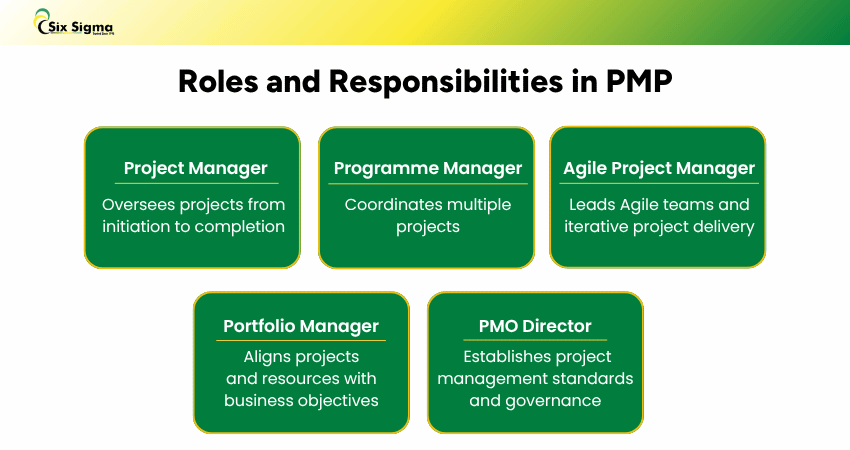
a) Champions: Champions align Six Sigma initiatives with organisational goals, select high-priority projects, allocate resources, and remove barriers that could affect project success.
b) Master Black Belts (MBBs): Master Black Belts provide strategic guidance for Six Sigma deployment. They mentor Black Belts and Green Belts, oversee complex initiatives, and ensure consistent application of Six Sigma methodologies.
c) Black Belts: Black Belts lead improvement projects full-time, using data analysis and problem-solving techniques to identify root causes, implement solutions, and deliver measurable business results.
d) Green Belts: Green Belts manage smaller process improvement projects alongside their regular responsibilities. They collect and analyse data, apply Six Sigma tools, and support operational improvements within their departments.
e) Process Owners: Process Owners are responsible for maintaining improvements after project completion. They monitor performance, track key metrics, and ensure the benefits of process changes are sustained over time.
Project Management Professional (PMP®) Certification is a globally recognised credential that validates a professional's knowledge, skills, and experience in managing projects effectively. Offered by the Project Management Institute (PMI), it demonstrates the ability to lead projects, manage teams, control risks, and deliver successful outcomes using recognised Project Management principles and practices.
The PMP® Certification covers key areas of Project Management, including planning, execution, monitoring, risk management, stakeholder engagement, and project delivery. It equips professionals with practical skills to manage projects throughout their lifecycle while adapting to different delivery approaches, including predictive, Agile, and hybrid methodologies.
PMP certified professionals can take on a variety of Project Management roles, from leading individual projects to overseeing
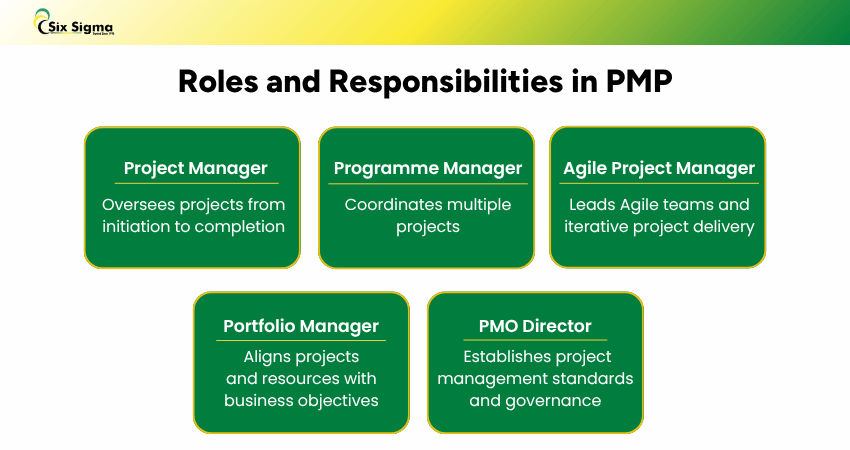
a) Project Manager: Project Managers oversee projects from initiation to completion. They manage scope, schedules, budgets, risks, and stakeholder expectations to ensure successful project delivery.
b) Programme Manager: Programme Managers coordinate multiple related projects to achieve broader strategic goals. They ensure projects work together effectively and deliver long-term business value.
c) Agile Project Manager: These professionals lead Agile project delivery by facilitating collaboration, managing iterative workflows, and helping teams adapt to changing requirements.
d) Portfolio Manager: Portfolio Managers oversee an organisation's collection of projects and programmes. They prioritise investments, allocate resources, and ensure projects align with strategic business goals.
e) PMO Director: PMO Directors lead the Project Management Office (PMO), establishing Project Management standards, governance frameworks, and best practices to improve project performance.
Drive efficiency and reduce operational waste with the Six Sigma Green Belt Training – Join now!
Understanding the differences between Six Sigma and PMP can help professionals choose the certification that best aligns with their career goals. Let’s learn about Six Sigma vs PMP below:
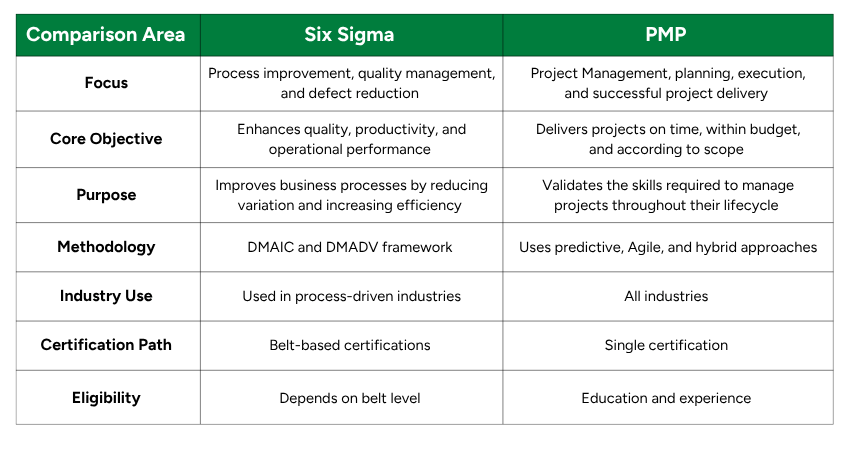
Earning a Six Sigma Certification typically involves selecting the appropriate belt level based on your experience and career goals, such as Yellow Belt, Green Belt, or Black Belt. Individuals can complete the training and learn methodologies such as Define, Measure, Analyse, Improve, and Control (DMAIC). Some advanced certifications also require practical project experience or the successful completion of a real-world improvement project.
In contrast, earning the PMP® Certification requires professionals to meet specific education, Project Management experience, and training requirements before applying for the examination. Eligibility depends on the individual’s educational background and required Project Management training. Once certified, professionals must earn Professional Development Units (PDUs) to maintain their certification and stay up to date with evolving Project Management practices.
Six Sigma uses two primary methodologies such as DMAIC for improving existing processes and Define, Measure, Analyse, Design, and Verify (DMADV) for designing new processes or products. These structured frameworks help organisations identify inefficiencies, reduce defects, and improve process performance through data-driven analysis.
In contrast, PMP uses PMBOK-based Project Management practices alongside Agile, predictive, and hybrid approaches. It equips professionals to manage projects across the entire project lifecycle, with a focus on delivering value, managing stakeholders, controlling risks, and achieving project objectives within scope, time, and budget.
Some Six Sigma Certifications remain valid for life, while others require renewal, continuing education, recertification, or evidence of ongoing professional practice. You need to renew the necessary Six Sigma Certifications.
In contrast, PMP® Certification holders must earn 60 Professional Development Units (PDUs) every three years to maintain their credential. This requirement ensures professionals continue developing their Project Management knowledge and skills with evolving project needs.
Six Sigma originated in manufacturing and is widely used to improve quality, reduce defects, and optimise processes. Today, it is also applied across healthcare, logistics, finance, retail, service industries, supply chain management, and telecommunications to improve operational efficiency.
In contrast, PMP is recognised across a wide range of industries, including IT, construction, healthcare, finance, manufacturing, and marketing. Its project-focused approach makes it valuable in almost any sector.
Six Sigma Certifications are available at various levels including Yellow Belt, Green Belt, and Black Belt. Eligibility requirements vary depending on the certification level, with advanced levels often requiring relevant work experience or project involvement.
In contrast, PMP® Certification follows a standardised eligibility process with specific education, Project Management experience, and training requirements. Professionals typically need a secondary diploma with at least 60 months of project leadership experience, a four-year degree with at least 36 months of experience, or a Global Accreditation Centre (GAC) accredited degree with at least 24 months of experience. They must also complete 35 hours of Project Management education.
Six Sigma follows a belt-based hierarchy consisting of White Belt, Yellow Belt, Green Belt, Black Belt, and Master Black Belt. Each level reflects increasing expertise and responsibility in process improvement.
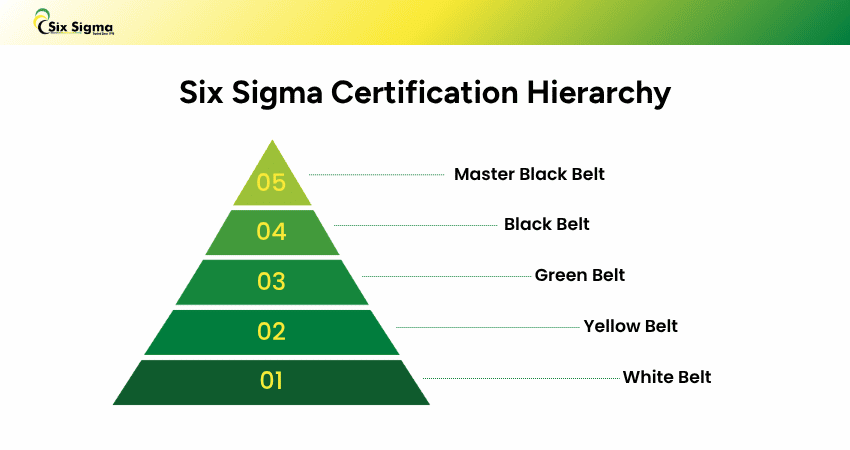
In contrast, PMP is a standalone certification that validates Project Management competence. There are no progressive PMP levels beyond the certification itself.
Six Sigma Certifications are administered by multiple organisations and professional associations including the American Society for Quality (ASQ) and the International Association for Six Sigma Certification (IASSC).
In contrast, PMP® Certification is administered by the Project Management Institute (PMI), which establishes the certification framework, examination standards, and renewal requirements. This standardised approach ensures that PMP® Certification is recognised and valued consistently across industries worldwide.
Build a strong foundation in Six Sigma by joining the Six Sigma Yellow Belt Training now!
Although Six Sigma and PMP® Certifications have different objectives and methodologies, they share several important similarities. Let’s explore the similarities below:
Both certifications validate advanced knowledge and practical experience in managing projects, processes, and organisational objectives. They demonstrate a professional's ability to lead teams, solve problems, and drive business improvements effectively.
Six Sigma and PMP® Certifications are recognised globally, making them valuable credentials for professionals seeking opportunities across different countries and industries. Their international reputation enhances career mobility and employability.
Both certifications contribute to successful project outcomes, although they approach Project Management differently. PMP focuses on planning, executing, and controlling projects, while Six Sigma emphasises improving processes, reducing defects, and increasing operational efficiency.
Choosing between Six Sigma and PMP® Certifications depends on your current role, career aspirations, and professional interests. Six Sigma is ideal for professionals interested in quality management, process improvement, and operational efficiency. If your goal is to reduce defects, improve performance, and optimise business processes, Six Sigma is the ideal choice. It provides the tools and methodologies needed to drive continuous improvement and deliver measurable results.
On the other hand, if you want to build a career in Project Management, lead teams, and oversee projects from planning to completion, PMP® is the more suitable choice. It equips professionals with the knowledge and skills needed to manage projects across various industries.
When comparing Six Sigma vs PMP, the best choice depends on your career goals and area of expertise. PMP is ideal for professionals focused on project leadership, while Six Sigma suits those interested in process optimisation. Choosing the right certification can help strengthen your skills, enhance career prospects, and support long-term professional growth.
Build quality-driven leadership capabilities by joining the Six Sigma Courses now!


Thank You For Your Enquiry.
Our representative will get in touch with you shortly. You can also:Call Us: +442036084550
Email Us: info@sixsigma.co.uk



 Home
Home