
Call us:
+442036084550
Monday-Sunday (24 Hours)


 2026-05-01
James Smith
Have you ever faced a situation where the same issue keeps coming back, like customers complaining about delays, errors in reports, or processes taking longer than they should? It often feels like you fix the problem for a while, but it returns again, causing frustration and wasted effort. This is exactly where DMAIC helps by providing a clear way to understand and fix problems properly.
To see how this approach works in practice, in this blog, you will explore how DMAIC works, its phases, and real-world examples across different industries. Let’s take a closer look!
DMAIC is a structured, data-driven approach used in Lean Six Sigma to improve and optimise existing processes. It stands for Define, Measure, Analyse, Improve, and Control, which are the five phases followed to identify problems, understand their causes, and implement effective solutions.
In simple terms, DMAIC helps organisations find the root cause of issues, improve performance, and maintain long-term results. It is widely used to reduce errors, increase efficiency, and ensure processes remain stable over time. This makes it a reliable method for achieving consistent and measurable business improvements.

Selecting a good project is the foundation of a successful DMAIC initiative, as it ensures efforts focus on meaningful and measurable improvements. To choose the right project, consider the following:
a) Focus on Impact and Manageability: Choose a project that solves a significant problem but is not overly complex, so it can be completed effectively within a reasonable timeframe.
b) Target Clear Problems: Select processes with visible issues such as high defect rates, delays, or inefficiencies that require structured improvement.
c) Ensure Measurability: The project should include clear KPIs and metrics to track current performance and measure improvements accurately.
d) Check Data Availability: Ensure that reliable data is available or can be easily collected to support analysis and decision-making.
e) Align with Business Goals: Choose a project that supports organisational objectives, such as reducing costs, improving quality, or increasing productivity.
f) Establish a Project Foundation: Develop a clear project charter, secure management support, and consider a pilot run to minimise risks and ensure successful implementation.
The DMAIC methodology consists of five structured phases that help teams identify problems, find root causes, and implement lasting improvements using a data-driven approach. Each phase builds on the previous one, creating a clear and systematic path for process improvement. Let’s explore each phase step by step:
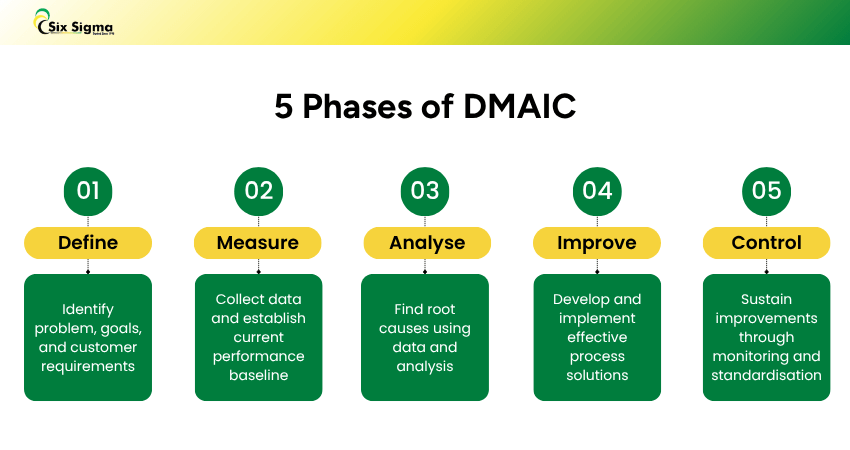
The Define phase focuses on identifying the problem and setting clear project goals. Teams create a project charter, map the process at a high level, and understand customer needs. They also conduct process walkthroughs and engage with stakeholders to build a strong foundation. This phase ensures everyone is aligned on the problem, scope, and objectives before moving forward.
In the Measure phase, teams collect data to understand how the process is currently performing. They focus on key metrics such as lead time, defects, or quality and establish a baseline. This baseline acts as a reference point for future comparisons, helping teams quantify the problem and identify performance gaps accurately.
The Analyse phase is intended to identify the root causes of the problem. Teams study the collected data, observe process behaviour, and test assumptions to confirm what is truly causing the issue. This step ensures that solutions target the real problem, not just its symptoms. It helps teams avoid ineffective fixes and focus on long-term, sustainable improvements.
During the Improve phase, teams develop and implement solutions to address the root causes. They test ideas, refine them, and apply the most effective changes. Data is then used to confirm that these improvements lead to measurable results. This phase focuses on achieving practical and lasting enhancements in process performance.
The Control phase ensures that improvements are stable over time. Teams create monitoring and response plans, standardise processes, and assign responsibility to maintain performance. They also create response plans to address any deviations quickly. This helps prevent the problem from recurring and supports continuous, long-term improvement.
Learn essential tools to support improvement projects effectively through the Lean Six Sigma Yellow Belt Training – Join today!
DMAIC is widely used because it brings clarity and structure to process improvement. By following a logical, step-by-step method, it helps organisations move from identifying a problem to implementing and sustaining effective solutions. To understand its purpose, consider the following:
a) Creates a Clear Direction: DMAIC defines problems and goals clearly, helping teams stay focused throughout the improvement process.
b) Improves Problem Understanding: DMAIC breaks down complex issues, making it easier to analyse and address them effectively.
c) Reduces Guesswork: By relying on structured analysis, it minimises trial-and-error approaches in decision-making.
d) Standardises Improvement Efforts: DMAIC provides a consistent method that can be applied across different processes and teams.
e) Strengthens Process Control: DMAIC ensures processes are continuously monitored and kept stable after improvements are made.
f) Supports Organisational Growth: By improving processes systematically, it helps organisations achieve better performance over time.
DMAIC offers a structured and data-driven approach to improving business processes, helping organisations achieve better performance and long-term results. Its benefits go beyond short-term fixes by focusing on efficiency, quality, and sustainable improvement. Key benefits include:
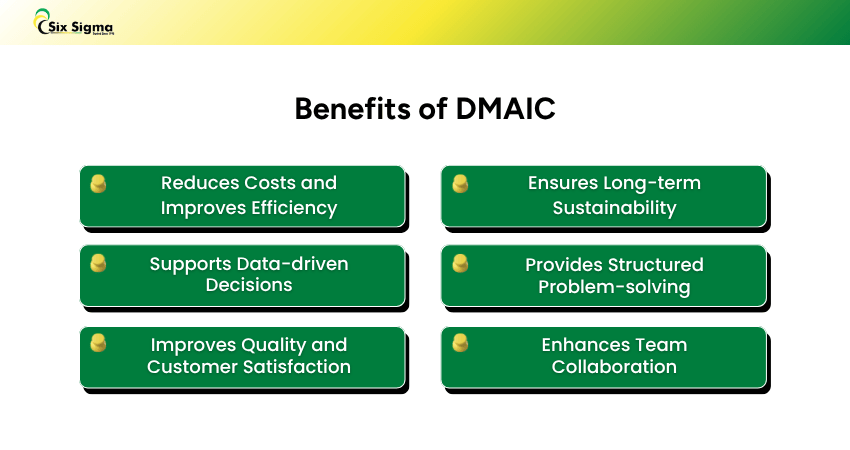
a) Reduces Costs and Improves Efficiency: DMAIC eliminates waste and minimises defects, helping organisations lower operational costs and improve productivity.
b) Supports Data-driven Decisions: DMAIC uses accurate data to identify problems and guide solutions, ensuring more reliable and effective outcomes.
c) Improves Quality and Custome r Satisfaction: By reducing errors and process variation, organisations can deliver consistent, high-quality products and services.
d) Ensures Long-term Sustainability: The Control phase helps maintain improvements through monitoring and standardisation, preventing processes from reverting.
e) Provides Structured Problem-solving: The five-phase framework offers a clear and systematic approach to identifying and resolving issues.
f) Enhances Team Collaboration: DMAIC encourages cross-functional teamwork, improving communication and shared responsibility for outcomes.
Gain Green Belt expertise to drive continuous improvement with the Lean Six Sigma Green Belt Training – Register soon!
DMAIC can be applied across various industries to improve processes, reduce errors, and increase efficiency in a structured and data-driven way. Its flexibility makes it suitable for both operational and strategic improvements across different sectors. Let’s explore some practical examples:
Hospitals use DMAIC to reduce patient readmissions by identifying causes such as poor discharge planning and lack of patient awareness. By improving discharge procedures and strengthening patient education, healthcare providers can enhance care quality and reduce repeat visits. This leads to better patient outcomes and more efficient use of healthcare resources.
Manufacturing companies apply DMAIC to reduce defects by analysing issues like machine faults, material problems, or operator errors. By improving production processes, maintaining equipment regularly, and training staff, organisations achieve more consistent product quality. This also increases operational efficiency and reduces production costs over time.
Call centres use DMAIC to reduce customer wait times by identifying causes such as insufficient staffing, inefficient call routing, or outdated systems. By optimising processes and improving workforce planning, organisations can respond faster to customer queries. This results in improved service quality and higher customer satisfaction levels.
Financial institutions use DMAIC to streamline processes like loan approvals by identifying delays and inefficiencies. By introducing automation and simplifying workflows, they reduce processing time, improve accuracy, and provide a better customer experience.
Organisations use DMAIC to optimise inventory levels by addressing issues like inaccurate demand forecasting and inefficient ordering. Improved planning, better data analysis, and continuous monitoring help maintain optimal stock levels. This reduces costs, prevents stockouts, and ensures timely product availability.
DMAIC offers a powerful and practical way to improve processes and solve problems with confidence. By focusing on data, root causes, and continuous monitoring, organisations can achieve better quality, higher efficiency, and consistent results. Adopting this approach helps drive long-term improvements and supports sustainable business growth.
Build data-driven skills to optimise business performance effectively with the Lean Six Sigma Training – Join now!


Thank You For Your Enquiry.
Our representative will get in touch with you shortly. You can also:Call Us: +442036084550
Email Us: info@sixsigma.co.uk



 Home
Home