

Call us:
+442036084550
Monday-Sunday (24 Hours)


 2026-05-14
James Smith

Ever been asked an interview question that made your mind go blank? Six Sigma interviews can feel exactly like that, especially when topics like DMAIC, Lean Six Sigma, SPC, and process improvement techniques appear. Preparing for common Six Sigma Interview Questions can help you answer confidently and leave a strong impression during interviews.
Whether you are preparing for your first quality management role or aiming for career growth, knowing what interviewers expect gives you an advantage. This blog covers commonly asked Six Sigma Interview Questions and answers in a simple and beginner-friendly way to help improve your interview performance. Let's get started!
Prepare for success with these frequently asked Six Sigma Interview Questions for beginners. The following questions cover important Six Sigma concepts, methodologies, and quality improvement techniques commonly discussed during interviews:
Six Sigma is a quality improvement methodology used to reduce defects and improve business processes. It focuses on identifying errors, analysing data, and enhancing performance through structured approaches such as Define, Measure, Analyse, Improve, Control (DMAIC) and Define, Measure, Analyse, Design, Verify (DMADV) to achieve better quality, efficiency, and customer satisfaction.

Six Sigma is important because it helps organisations improve quality, reduce waste, and increase customer satisfaction. By identifying defects and process inefficiencies, businesses can save time and reduce operational costs.
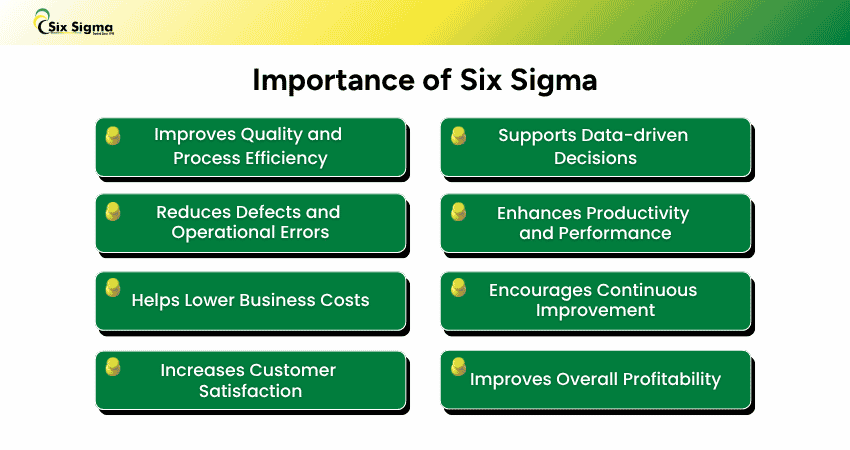
It also supports better decision-making through Data Analysis. Organisations that implement Six Sigma often experience improved productivity, stronger customer trust, and more consistent business performance.
Six Sigma was introduced by Bill Smith at Motorola in 1986. He developed the methodology to improve manufacturing quality and reduce process defects. Later, Jack Welch helped popularise Six Sigma by implementing it across General Electric, making it widely recognised around the world.
A Six Sigma professional should have strong analytical, problem-solving, communication, and leadership skills. They must be able to interpret data, identify process issues, and recommend improvements while understanding quality tools such as Pareto charts, control charts, root cause analysis, and basic Project Management concepts.
A Six Sigma level measures how well a process performs by identifying the number of defects produced. A higher sigma level means fewer defects and better process quality. At the Six Sigma level, a process produces only 3.4 Defects Per Million Opportunities (DPMO). This represents a highly efficient and consistent process.
DPMO stands for Defects Per Million Opportunities. It measures the number of defects in a process relative to the total number of opportunities for defects.
The formula for DPMO is:

a) Total Defects (D): The total number of defects identified in the sample
b) Units (U): The total number of products or items produced or inspected
c) Opportunities (O): The total number of possible defect points in each unit
For example, if a process creates 20 defects in 5,000 units with 2 defect opportunities per unit, the DPMO can be calculated using the above formula.
A 1.5 sigma shift is a concept in Six Sigma that assumes process performance may naturally shift over time. It accounts for long-term process variations that can occur in real-world operations. This shift explains why Six Sigma performance is considered equal to 3.4 defects per million opportunities instead of absolute perfection.
The primary principles of Six Sigma include:
a) Focusing on customer requirements
b) Using data-driven decision-making
c) Reducing process variation
d) Improving process flow
e) Preventing defects rather than correcting them later
f) Encouraging continuous improvement
These principles help organisations improve quality and efficiency consistently.
Develop advanced problem-solving skills for high-impact quality improvement projects through the Six Sigma Black Belt Upgrade Training – Sign up now!
The Pareto Principle is also known as the 80/20 rule. It states that around 80% of problems are often caused by 20% of the factors. In Six Sigma, this principle helps teams identify the most significant causes of defects or issues. By focusing on the major causes first, organisations can achieve better improvement results.
Lean focuses on eliminating waste and improving process speed, while Six Sigma focuses on reducing defects and process variation. Lean aims to improve workflow efficiency, whereas Six Sigma uses statistical analysis to improve quality. Many organisations combine both methodologies to create Lean Six Sigma for better operational performance.
Lean Six Sigma is a combined methodology that uses Lean principles and Six Sigma techniques together. It helps organisations improve quality while reducing waste and delays. The approach focuses on improving customer value, increasing process efficiency, and reducing operational errors through continuous improvement methods.
DMAIC is a structured problem-solving methodology used in Six Sigma for improving existing processes. The five phases of DMAIC are:
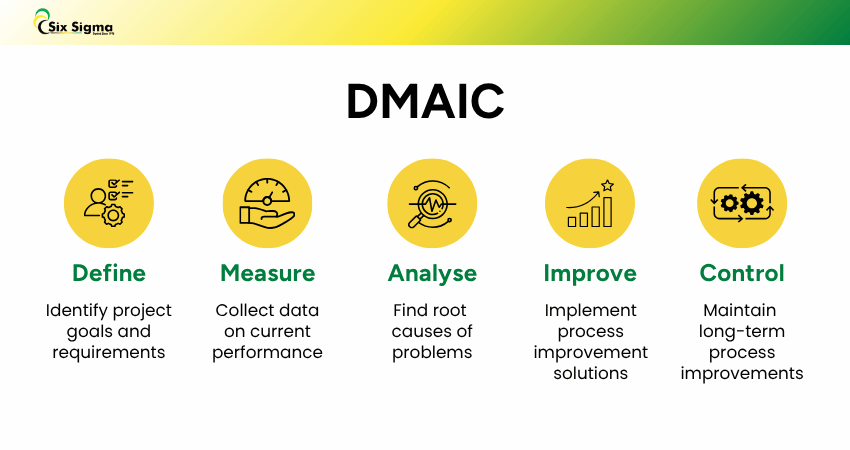
a) Define: Identify project goals and customer requirements
b) Measure: Collect data to assess current performance
c) Analyse: Identify root causes of process problems
d) Improve: Implement solutions to improve process efficiency
e) Control: Monitor processes to maintain long-term improvements
Each stage helps teams identify problems, analyse data, implement improvements, and maintain long-term process performance.
DMADV is a Six Sigma methodology mainly used for designing new products or processes. It stands for:
a) Define: Identify project goals and customer requirements
b) Measure: Measure customer needs and process capabilities
c) Analyse: Analyse design options and process requirements
d) Design: Create detailed process or product designs
e) Verify: Test and confirm process performance effectiveness
Unlike DMAIC, which improves existing processes, DMADV focuses on creating new processes that meet customer expectations from the beginning.
In Six Sigma, variation refers to differences in process output that affect quality and consistency. Reducing variation is a main objective of Six Sigma to achieve better quality and fewer defects. The two main types of variation are:
1) Common Cause Variation:
This is natural and expected variation within a stable process, also known as random variation. It can only be reduced by making fundamental changes to the process.
2) Special Cause Variation:
This is an unexpected variation caused by specific external factors, also known as assignable cause variation. It must be identified and eliminated quickly to restore process stability.
Gain recognised Six Sigma qualifications to strengthen your professional process improvement skills with the Six Sigma Yellow Belt Training – Join now!
Statistical Process Control (SPC) is a method used to monitor and control processes using statistical techniques. It helps organisations identify process variations before defects occur. SPC uses tools such as control charts and process capability analysis to maintain consistent quality and improve production performance.
Control charts are graphical tools used to monitor process performance over time. They help identify whether a process is stable or affected by unusual variations.
Some common rules for using control charts include:
a) Data points should stay within control limits
b) Patterns or trends may indicate process issues
c) Sudden shifts or repeated variations should be investigated
d) Charts should be updated regularly for accurate monitoring
Control charts help organisations maintain process consistency and quality.
X-bar and R charts are types of control charts used in Statistical Process Control (SPC) to monitor process stability.
1) X-bar Chart: The X-bar chart monitors the average value of a process over time. It helps identify whether the process means shifting or remaining consistent.
2) R Chart: The R chart monitors the range or variation within each sample group. It helps detect changes in process variation that may affect overall quality.
Together, these charts provide a complete picture of process stability by tracking both the process average and variation over time.
Standard deviation is a statistical measure that shows how much data varies from the average value. A low standard deviation means the data points are close to the mean or average value, while a high standard deviation indicates greater variation. In Six Sigma, reducing standard deviation helps improve process consistency.
Regression analysis is a statistical technique used to study the relationship between variables. It helps organisations understand how one factor affects another. In Six Sigma, regression analysis is commonly used to identify root causes, predict outcomes, and support data-driven decision-making.
Process Capability Index (Cpk) and Process Performance Index (Ppk) are process capability indices used in Six Sigma to measure process performance.
a) Cpk measures process capability during stable operating conditions
b) Ppk measures overall process performance over time, including process variations
Cpk focuses on short-term capability, while Ppk evaluates long-term performance.
A defect is a failure to meet a customer requirement or quality standard. It refers to a specific issue within a product, service, or process. A defective item is a product or output containing one or more defects. For example, one product may contain multiple defects but still count as one defective unit.
COPQ stands for Cost of Poor Quality. It refers to the costs associated with defects, errors, rework, customer complaints, and process failures. COPQ helps organisations understand the financial impact of poor quality. Reducing COPQ improves profitability and customer satisfaction.
FMEA stands for Failure Modes and Effects Analysis. It is a risk assessment tool used to identify possible process or product failures before they occur. FMEA helps organisations prioritise risks based on severity, occurrence, and detection. It supports preventive action and process improvement.
Develop Lean Six Sigma skills to lead successful process improvement projects with the Six Sigma Green Belt Training – Join today!
Root cause analysis is a method used to identify the main cause of a problem. The common steps include:
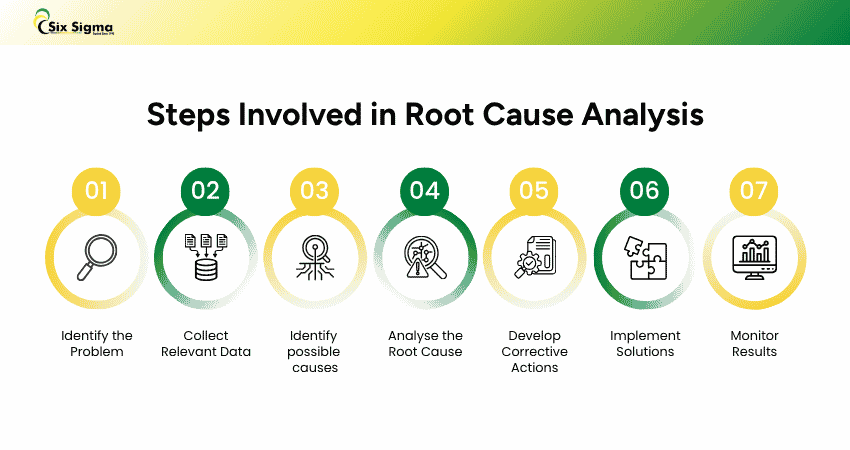
a) Identify the problem
b) Collect relevant data
c) Identify possible causes
d) Analyse the root cause
e) Develop corrective actions
f) Implement solutions
g) Monitor results
Tools such as the 5 Whys and Fishbone Diagram are often used during this process.
SIPOC is a process mapping tool used in Six Sigma. SIPOC stands for:
a) Suppliers
b) Inputs
c) Process
d) Outputs
e) Customers
It provides a high-level overview of a process and helps teams understand process relationships before starting improvement activities.
Voice of the Customer (VOC) refers to customer expectations, preferences, and feedback about products or services. Six Sigma teams collect VOC data through surveys, interviews, reviews, and customer interactions. Understanding VOC helps organisations improve customer satisfaction and product quality.
Lean Six Sigma offers several benefits to organisations, including:
a) Improved process quality
b) Reduced operational costs
c) Faster process completion
d) Better customer satisfaction
e) Reduced waste and defects
f) Improved teamwork and productivity
g) Data-driven decision-making
These benefits help organisations improve efficiency and maintain competitive advantages.
Preparing for common Six Sigma Interview Questions can help you confidently showcase your quality management and problem-solving skills during interviews. From DMAIC to Lean Six Sigma concepts, understanding these key topics improves your chances of success. Strong Six Sigma knowledge not only helps crack interviews but also supports long-term career growth across industries.
Build quality management expertise with the industry-focused Six Sigma Training – Register today!


Thank You For Your Enquiry.
Our representative will get in touch with you shortly. You can also:Call Us: +442036084550
Email Us: [email protected]



 Home
Home