

Call us:
+442036084550
Monday-Sunday (24 Hours)


 2026-03-31
James Smith

Tired of fixing the same problems again and again in your operations? It can be frustrating when issues keep coming back, wasting time, increasing costs, and affecting the quality of your work. No matter how much effort you put in, these inefficiencies make it difficult to maintain consistent quality and meet customer expectations. This indicates that you need Six Sigma Principles.
Rather than just treating problems on the surface, Six Sigma helps you identify the root causes and fix them for good. In this blog, we will explore the Six Sigma Principles and how they can benefit your organisation. Let’s get started!
Six Sigma is a structured, data-driven approach designed to improve business processes by reducing defects, minimising variation, and enhancing overall quality. What makes Six Sigma particularly powerful is its combination of statistical analysis and practical problem-solving methods.
Rather than relying on assumptions or guesswork, it encourages organisations to make decisions based on measurable data. This approach ensures that improvements are not only effective but also sustainable over time.

Six Sigma is built on several important principles that guide how businesses improve their processes. These principles are easy to understand and can be applied in everyday work to achieve better results. Let’s explore the key Six Sigma Principles below:
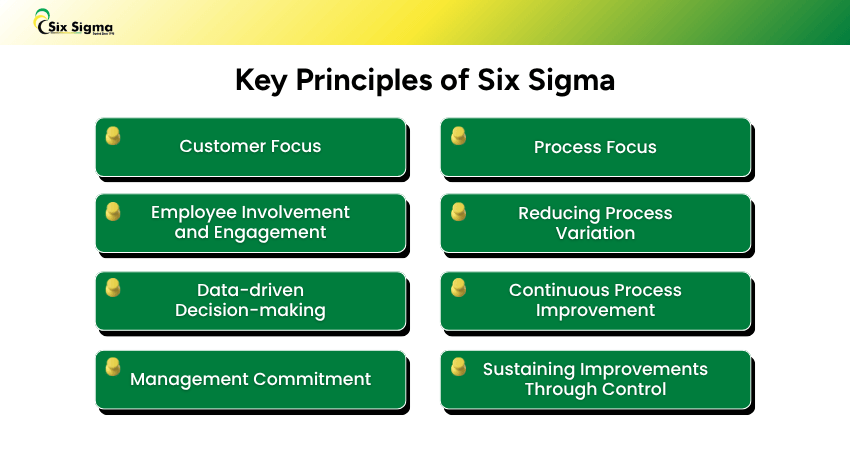
The foundation of Six Sigma lies in understanding and meeting customer needs. Every improvement effort starts with identifying customer needs, such as better quality, faster service, or lower costs. When businesses focus on what matters most to customers, they can deliver more value.
Six Sigma looks at work as a series of steps or processes. Instead of focusing on individual tasks, it studies how everything connects from start to finish. This approach is called process mapping, which uses flowcharts and graphs to visually represent the project processes. This helps businesses find areas where things slow down or go wrong.
Employees play a big role in Six Sigma. Everyone in the organisation, from junior level to senior leaders, is encouraged to take part in contributing to process improvement. When employees are involved, they feel more responsible and motivated to do better work. As a result, organisations can benefit from new ideas and more effective problem-solving.
Variation means differences in how a process performs each time. Too many variations can lead to inconsistent results. This can affect both your business quality and customer satisfaction. Six Sigma focuses on reducing these differences by finding their causes and making processes more consistent. The aim is to achieve reliable and predictable results every time.
One of the defining features of Six Sigma Principles is its reliance on data. Decisions are made based on factual evidence rather than intuition or assumptions. This means that you have to collect and analyse information before making any decisions. When decisions are based on facts, they improve accuracy and reduce the chances of making wrong decisions.
Six Sigma is not a one-time initiative. Instead, it is an ongoing journey of improvement, where businesses keep looking for ways to improve how they work and deliver their values. Even if the process is working well, there is always a way to make it better. This principle encourages organisations to regularly review their work and make changes when needed.
Strong support from senior management is required for the successful implementation of Six Sigma Principles. Leaders need to guide the process, provide resources, and support employees in their efforts. Without this commitment, it becomes difficult to achieve greater improvements. They also play a key role in setting clear goals and maintaining business quality.
Improving processes is important, but sustaining those improvements matters equally. To achieve this, Six Sigma focuses on using control methods to make sure these improvements last over time. This includes regularly checking performance, setting clear standards, and taking action if things start to go wrong.
Build a strong foundation in process improvement with Six Sigma Yellow Belt Training – Register today!
Six Sigma Principles uses specific methodologies to guide improvement efforts. The two most widely used approaches are DMAIC and DMADV, each designed for different types of projects. Let's explore each of them:
DMAIC stands for Define, Measure, Analyse, Improve, and Control. It is primarily used in Six Sigma Principles for improve existing processes that are not performing well. It follows five simple steps:
1) Define: Identify the problem, project goals, and customer requirements
2) Measure: Collect data to understand current performance levels
3) Analyse: Examine data to identify root causes of issues
4) Improve: Implement solutions to address the identified problems
5) Control: Monitor the process to ensure improvements are sustained
DMADV stands for Define, Measure, Analyse, Design, and Verify. It is used when creating new processes or products, particularly when existing ones do not meet customer expectations. The steps in DMADV are as follows:
1) Define: Establish project goals and customer requirements
2) Measure: Identify critical quality factors and metrics
3) Analyse: Develop design alternatives and evaluate them
4) Design: Create the new process or product
5) Verify: Test and validate the design to ensure it meets requirements
Lead high-impact improvement initiatives with Six Sigma Black Belt Training – Sign up soon!
Using Six Sigma Principles can bring many benefits to a business. Here are the key benefits:
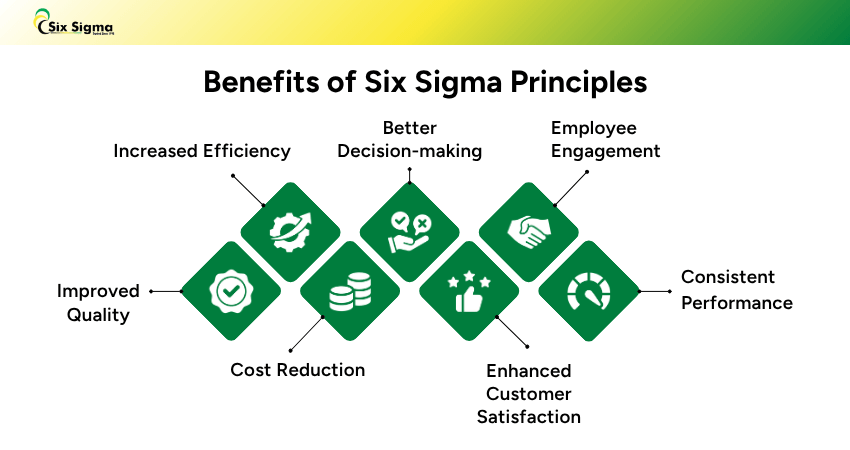
1) Improved Quality: Six Sigma helps reduce defects and errors, leading to higher-quality products and services. This ensures consistency and better customer satisfaction.
2) Increased Efficiency: By streamlining processes and removing unnecessary steps, businesses can complete tasks faster and more effectively.
3) Cost Reduction: Eliminating waste and inefficiencies helps lower operational costs and improve overall profitability.
4) Better Decision-making: Six Sigma relies on data and analysis, allowing businesses to make informed and accurate decisions rather than relying on guesswork.
5) Enhanced Customer Satisfaction: Focusing on customer needs ensures that products and services meet expectations, leading to stronger customer relationships.
6) Employee Engagement: Employees are actively involved in improvement initiatives, which boost motivation, collaboration, and productivity.
7) Consistent Performance: Standardised processes help deliver reliable and predictable results, reducing variability in outcomes.
Six Sigma Principles provide a practical and structured way for businesses to improve how they operate. These principles not only help solve existing issues but also prevent them from happening again. What makes Six Sigma truly valuable is its long-term impact. It encourages a culture of consistency, accountability, and continuous improvement across all levels of the organisation.
Learn how to reduce errors and optimise processes with Six Sigma Training – Join now!


Thank You For Your Enquiry.
Our representative will get in touch with you shortly. You can also:Call Us: +442036084550
Email Us: [email protected]



 Home
Home