
Call us:
+442036084550
Monday-Sunday (24 Hours)


 2026-07-18
James Smith
Have you ever thought about why some organisations consistently deliver high-quality products and services while others struggle with defects, inefficiencies, and customer complaints? The answer often lies in the Quality Management approach they adopt. This is why Six Sigma vs ISO 9001 is a common comparison, as both frameworks help organisations improve quality and business performance through different approaches.
In this blog, we'll explore ISO 9001 vs Six Sigma, covering their key differences, similarities, benefits, and core concepts. By the end, you'll have a clear understanding of which framework best aligns with your organisation's quality improvement goals and business needs. Let's dive in!
ISO 9001 is a globally recognised international standard for Quality Management Systems (QMS) developed by the International Organization for Standardization. It offers a structured framework to help organisations consistently deliver quality products and services while meeting customer, legal, and regulatory requirements. Designed for organisations across all industries and sizes, ISO 9001 supports consistent processes and operational excellence.
Rather than prescribing specific business practices, ISO 9001 focuses on improving processes, managing risks, and driving continual improvement. Implementing the standard helps organisations enhance efficiency, reduce errors, improve customer satisfaction, and demonstrate a strong commitment to quality through internationally recognised certification.
ISO 9001 is based on a set of Quality Management principles that help organisations improve performance and deliver consistent results. These principles provide a framework for enhancing efficiency, customer satisfaction, and continual improvement. The seven principles are:
1) Customer Focus: Understand customer requirements and provide products and services that consistently exceed expectations.
2) Leadership: Establish a clear vision and create a culture that supports quality objectives.
3) Engagement of People: Encourage employees at all levels to contribute their skills and knowledge.
4) Process Approach: Manage activities as interconnected processes to improve efficiency and consistency.
5) Improvement: Promote continual improvement to enhance products, services, and organisational performance.
6) Evidence-based Decision-making: Use accurate data and analysis to make informed business decisions.
7) Relationship Management: Build strong relationships with suppliers and stakeholders to create long-term value.
Implementing ISO 9001 offers several advantages that extend beyond quality assurance. It helps organisations improve efficiency, strengthen customer confidence, and support long-term business growth. Some of the key benefits include:
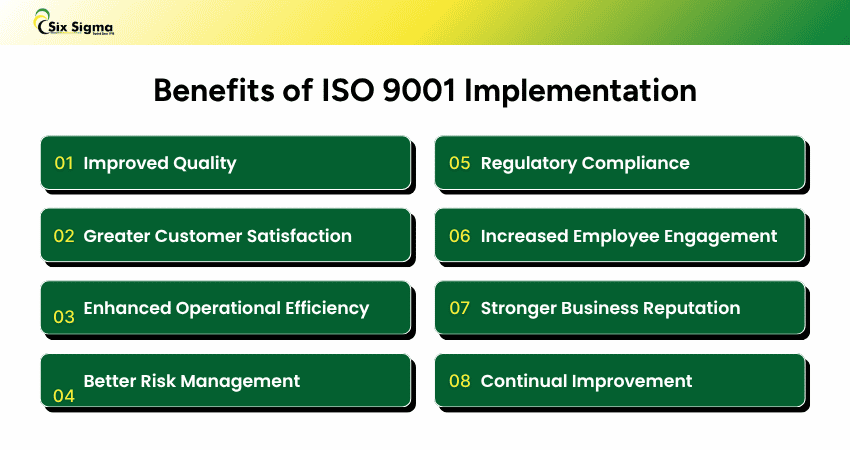
1) Improved Quality: Delivers consistent products and services through standardised processes.
2) Greater Customer Satisfaction: Meets customer expectations and strengthens trust.
3) Enhanced Operational Efficiency: Streamlines workflows and reduces waste and errors.
4) Better Risk Management: Identifies and addresses risks before they affect performance.
5) Regulatory Compliance: Supports compliance with applicable legal and industry requirements.
6) Increased Employee Engagement: Encourages collaboration and accountability across teams.
7) Stronger Business Reputation: Demonstrates a commitment to quality and enhances market credibility.
8) Continual Improvement: Promotes ongoing evaluation and refinement of processes to improve performance and achieve long-term business success.
Six Sigma is a data-driven methodology that helps organisations improve quality by reducing defects, minimising process variation, and enhancing operational efficiency. Originally developed by Motorola in the 1980s, it is now widely used across industries to deliver consistent and measurable results.
Using frameworks such as DMAIC (Define, Measure, Analyse, Improve, and Control), Six Sigma helps organisations identify process inefficiencies and implement effective long-term solutions to improve quality. This leads to improved quality, lower costs, greater efficiency, better process performance, and higher customer satisfaction.
Six Sigma is based on core concepts that help organisations improve quality through structured, data-driven processes. These concepts focus on reducing defects, minimising variation, and achieving consistent results. The key concepts include:
1) DMAIC (Define, Measure, Analyse, Improve, Control): Improves existing processes by identifying problems, implementing solutions, and sustaining improvements.
2) DMADV (Define, Measure, Analyse, Design, Verify): Designs new products or processes that meet customer and quality requirements.
3) Data-driven Decision-making: Uses statistical analysis and measurable data to guide decisions.
4) Defect Reduction: Eliminates the root causes of defects to improve quality.
5) Variation Reduction: Reduces process variation to achieve consistent performance.
6) Near-perfect Performance: Aims for no more than 3.4 defects per million opportunities (DPMO).
Implementing Six Sigma helps organisations improve quality, increase efficiency, and achieve measurable business results. By reducing defects and improving processes, it supports long-term operational excellence. Some of the key benefits include:
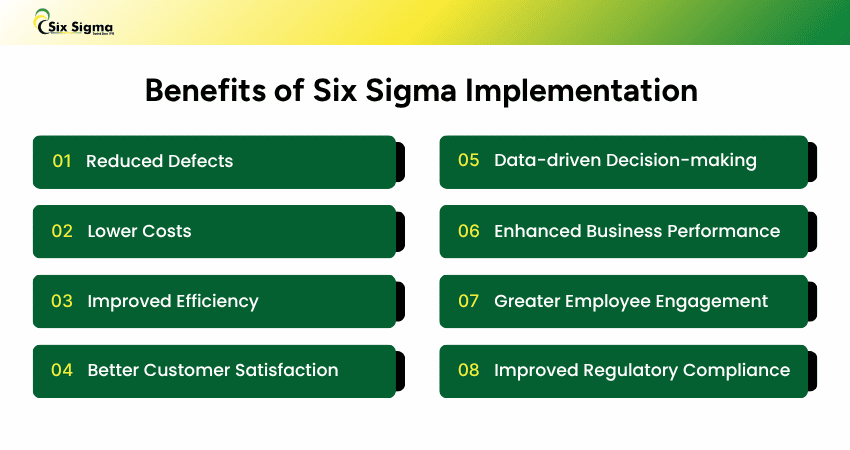
1) Reduced Defects: Minimises errors and improves product and service quality.
2) Lower Costs: Reduces waste, rework, and unnecessary operational expenses.
3) Improved Efficiency: Streamlines processes to increase productivity and performance.
4) Better Customer Satisfaction: Delivers more consistent products and services that meet customer expectations.
5) Data-driven Decision-making: Supports informed decisions using measurable data and statistical analysis.
6) Enhanced Business Performance: Strengthens competitiveness through continuous process improvement.
7) Greater Employee Engagement: Encourages teamwork, accountability, and structured problem-solving.
8) Improved Regulatory Compliance: Helps organisations maintain consistent processes that support compliance with industry standards and regulatory requirements.
Lead complex improvement projects with the Lean Six Sigma Black Belt Training – Sign up now!
While both ISO 9001 and Six Sigma aim to improve quality and business performance, they differ in their approach, implementation, certification, and tools. Understanding the Differences Between ISO 9001 and Six Sigma helps organisations choose the framework that best suits their objectives:
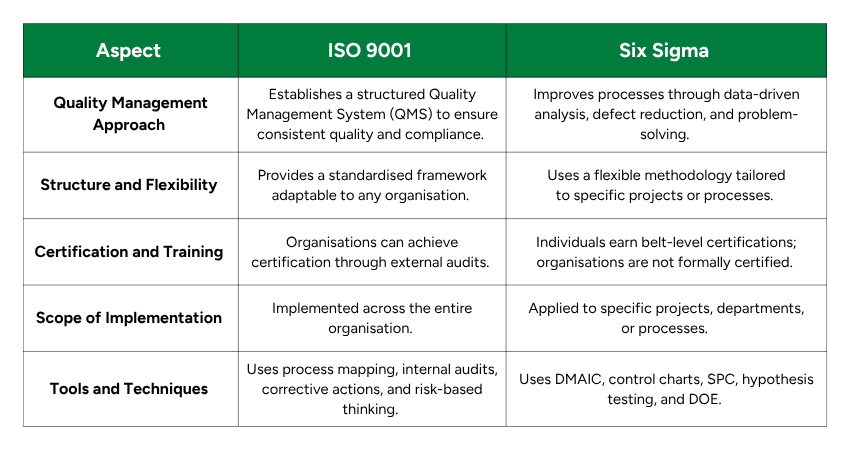
ISO 9001: Focuses on establishing a structured Quality Management System (QMS) with defined processes, documentation, and regular audits to ensure consistent quality and compliance.
Six Sigma: Focuses on improving process performance through data-driven analysis, defect reduction, and structured problem-solving methodologies.
ISO 9001: Provides a standardised framework that organisations can adapt while meeting the requirements of the standard.
Six Sigma: Offers a flexible methodology, allowing organisations to choose tools and techniques based on the specific process or project.
ISO 9001: Organisations can achieve certification by successfully completing an external audit against the standard's requirements. Individuals may also pursue auditor or implementer certifications.
Six Sigma: Certification is awarded to individuals through belt levels such as White, Yellow, Green, Black, and Master Black Belt. Organisations themselves are not formally certified in Six Sigma.
ISO 9001: Implemented across the entire organisation to establish a consistent Quality Management System.
Six Sigma: Typically applied to specific projects, departments, or processes to improve quality, efficiency, and reduce defects.
ISO 9001: Uses tools such as process mapping, internal audits, corrective actions, and risk-based thinking to manage and improve quality.
Six Sigma: Relies on statistical methods and tools, including DMAIC, control charts, hypothesis testing, Statistical Process Control (SPC), and Design of Experiments (DOE), to identify and eliminate process inefficiencies.
Build a strong foundation in process improvement with the Lean Six Sigma Yellow Belt Training – Register today!
While ISO 9001 and Six Sigma differ in their approach, both share the common goal of improving quality, efficiency, and customer satisfaction. Both encourage organisations to adopt structured processes, make informed decisions, and drive continual improvement. Some of their key similarities include:
1) Focus on Quality: Both aim to improve the quality of products, services, and business processes.
2) Customer-centric Approach: Both prioritise meeting customer requirements and enhancing customer satisfaction.
3) Continuous Improvement: Both promote ongoing improvements to achieve better performance over time.
4) Process-based Thinking: Both encourage organisations to standardise and optimise processes for greater efficiency.
5) Data-driven Decisions: Both rely on data and performance measurements to identify opportunities for improvement.
6) Improved Operational Efficiency: Both help reduce inefficiencies, improve productivity, and support long-term business success.
The right choice depends on your organisation's objectives and quality improvement priorities. If you want to establish a structured Quality Management System (QMS), improve consistency, meet regulatory requirements, and achieve recognised certification, ISO 9001 is the ideal choice. It provides a strong framework for managing quality across the organisation.
If your goal is to reduce defects, improve process efficiency, lower costs, and solve operational challenges using data-driven methods, Six Sigma is the better option. Organisations seeking a comprehensive quality strategy can also implement both, combining ISO 9001's management framework with Six Sigma's process improvement methods for better overall performance.
Whether you're building a strong Quality Management System or striving to eliminate process inefficiencies, understanding ISO 9001 vs Six Sigma is the key to making informed decisions. By choosing the approach that aligns with your organisation's goals, you can improve quality, boost efficiency, enhance customer satisfaction, and achieve long-term business success.
Gain in-demand Lean Six Sigma skills to deliver lasting operational excellence and success with the Lean Six Sigma Training – Join now!


ISO 9001 provides a system for managing quality, while Six Sigma helps improve processes by reducing errors and waste. Together, they support continuous improvement, improve product and service quality, and help organisations achieve consistent results.


Thank You For Your Enquiry.
Our representative will get in touch with you shortly. You can also:Call Us: +442036084550
Email Us: info@sixsigma.co.uk



 Home
Home